
The short answer
SnapShove is the app that made jam-or-fold poker portable: enter your stack, position and table size, and it returns the Nash equilibrium answer to one question — shove or fold. It still answers that question correctly. It also holds 2.5 out of 5 stars on the US App Store, limits free users to one calculation per day, and has nothing to say about any spot where the best play is a raise smaller than all-in.
Four replacements cover what it did and the parts it never touched. Preflop+ ($129.99 lifetime) if you want Nash charts with drills bolted on. ICMIZER (from $17.99/mo) when bubbles and final tables make ICM matter. Free printable charts if you’re spending nothing. And GTO Preflop if you want the answer to the whole preflop game, where the jam is one line in a full strategy instead of the only line.
Note:
Full disclosure: GTO Preflop is our app. Every price and rating below was checked against the vendor’s own store page or website on August 19, 2026 (ICMIZER and HoldemResources on August 18), and re-checked on September 1, 2026. Where a rival beats us, we say so plainly.
SnapShove alternatives at a glance
| Platforms | Price (Aug 2026) | What it answers | |
|---|---|---|---|
| SnapShove | iPhone, iPad, Android | Free (1 calc/day); Core $3.99/mo or $34.99/yr; Unlimited $9.99/mo or $99.99/yr | Is this exact stack a Nash shove, call or reshove? |
| Preflop+ | iPhone, iPad, Android | $9.99/mo, $79.99/yr or $129.99 lifetime | Nash shove/fold charts plus equity drills and pot-odds tools |
| ICMIZER 3 | Desktop, web | Basic $17.99/mo or $99.99/yr; PRO $32.99/mo or $179.99/yr | What does ICM do to this shove or call on the bubble? |
| Free printable charts | Paper, PDF | Free | A memorizable skeleton of heads-up jam ranges |
| GTO Preflop | iPhone, iPad, Android, Apple Silicon Mac | Free download; Pro $19.99/mo or $119.99/yr | The full solved preflop strategy — jams, min-raises, calls and 3-bets, with training |
Why players are replacing SnapShove
Start with the number that sent you searching. As of August 19, 2026, SnapShove’s current iOS release holds 2.5 out of 5 stars across 22 US App Store ratings. Upswing Poker still lists it among the tools tournament players should use daily, and its Nash engine isn’t wrong. The app around the engine is what people are leaving.
The free tier is thin now: SnapShove’s own site describes the Starter plan as one shove, call or reshove calculation per day (training simulations stay unlimited, to its credit). And the store listing is a maze: six overlapping in-app purchases from $3.49 to $44.99, including a separate monthly subscription for reshove mode, while the website sells two tiers with different prices. Figuring out what you’d actually pay takes longer than the trial calculation you get that day.
But there’s a deeper problem, and it applies to every jam-or-fold tool, not SnapShove specifically. Push/fold is a smaller slice of tournament poker than the apps built around it suggest.
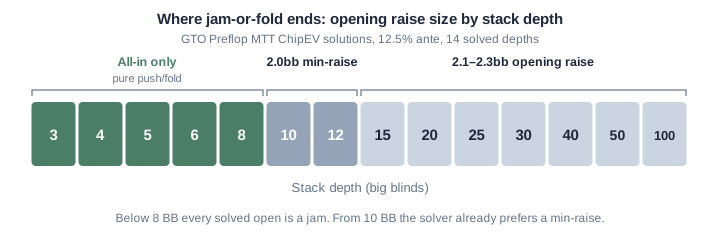
That chart comes from our own solve database. In GTO Preflop’s MTT ChipEV solutions, computed with a standard 12.5% ante, at 3 to 8 big blinds the all-in is the only opening raise in the tree — genuine push/fold poker. From 10 big blinds a 2bb min-raise appears beside it, and 2bb is still the solved opening size at 20; only at 25 does it widen to 2.1bb, and at 40 to 2.3bb. The pure jam-or-fold game ends around 8 big blinds. Above that the jam doesn’t vanish — it stops being the only choice, and that is the comparison a Nash calculator can’t make for you: it tells you whether a jam is profitable, not whether the min-raise was better.
We can also see the switch happening in our ad data. We run Apple Search Ads for GTO Preflop, and in the 30 days to August 11, 2026, the search term “snapshove” produced 5 taps and 3 attributed installs of our app, with “push fold” adding 3 more. Small numbers, and they’re floors, since a big share of App Store ad traffic carries no keyword attribution at all. The pattern matches what we found with Equilab: players type the name of the tool they know, then install the thing they were actually looking for.
1. GTO Preflop — the whole preflop game, jams included
GTO Preflop is a mobile preflop solver library and trainer for iPhone, iPad, Android and Apple Silicon Macs. The strategies are solved ahead of time and ship inside the app: 11,385 decision points and just under two million hand-specific strategies across 503 scenarios, covering cash games, MTT ChipEV and Spin & Go from 2-handed to 8-handed.
For a SnapShove user the relevant part is the short-stack coverage. MTT solves run at 14 depths from 3 to 100 big blinds with antes, and at 3–8 big blinds those files are true push/fold ranges — the all-in is the solved opening action, and facing-a-shove nodes give you the calling side too. The trainer deals MTT spots at 3 to 12 big blinds, grades every decision against the solution, and reports your EV loss per 100 hands with an ELO rating attached. That’s the piece a chart app can’t do: you don’t find out what you’ve memorized, you find out what you actually play. If you’re weighing that trainer against Dominik Nitsche’s, our DTO Poker vs GTO Preflop comparison runs the head-to-head.
Spin & Go players get more depth than anywhere else on this page: 17 even-stack depths from 1.5 to 34 big blinds plus 418 asymmetrical stack combinations. Short-stack tools usually assume everyone has the same stack; real spins almost never look like that. It matters, because solver estimates put 70–80% of Spin & Go winnings down to preflop play alone.
Honest limits. The depths are a fixed grid — with 7.3 big blinds you use the 8bb solve, where SnapShove’s calculator takes your exact number. ICM coverage is a single scenario, so bubble math belongs to ICMIZER below. And it’s preflop only, by design.
Free to download. Pro runs $19.99 a month or $119.99 a year on the standard plan, with a $7.99 weekly option. We run pricing experiments, so some users see different numbers. It holds 4.8 out of 5 across 240 US App Store ratings as of August 19, 2026.
Tip:
Test yourself where push/fold actually lives: get the app and run twenty trainer hands at 8 big blinds. If your EV loss comes back near zero, a chart app is genuinely all you need.
2. Preflop+ — Nash charts with a toolbox attached
Preflop+ (Crafty Wheel Studios) is the strongest chart-first replacement. Its store listing covers Nash shove/fold charts from 5 big blinds to 25 and above with exact EV numbers per hand, wrapped in a set of study modules: equity drills, pot-odds practice, combinatorics and custom ranges. Everything works offline. It carries 4.6 stars across roughly 1,000 US ratings.
The pricing is its best argument: $9.99 a month, $79.99 a year, or $129.99 once for lifetime access. If Nash charts plus drills are all you want, that lifetime license is the best value-per-dollar on this page, and we’d rather you buy it than keep paying SnapShove’s Unlimited tier for the same math.
What you give up is the strategy above the jam. Charts start at 5 big blinds and the focus stays on shove/fold; the min-raise game that takes over from 10 big blinds isn’t what it’s built for. It is actively maintained: version 25.9 shipped on August 10, 2026.
3. ICMIZER — when the money jumps change the answer
Everything above solves for chips. SnapShove says so itself: its ranges come from a ChipEV Nash equilibrium. Our MTT files are ChipEV too. That’s the right model for most of a tournament, and the wrong one near the bubble and at final tables, where busting costs you real-money equity that chip counts don’t capture.
ICMIZER 3 is the specialist for exactly that. It recalculates shove and call ranges under ICM with your actual payout structure, and its SNG Coach add-on ($40/yr on top) drills you on the results, with a mobile companion app. Basic costs $17.99 a month or $99.99 a year; PRO is $32.99 a month or $179.99 a year. Prices checked directly on icmizer.com on August 18, 2026. HoldemResources Calculator plays in the same league (Classic $16.66/mo or $119.90/yr, Pro $49.99/mo or $359.90/yr) if you prefer its workflow.
For ICM-adjusted push/fold work, ICMIZER beats every mobile app on this page, ours included. That’s a real vertical and it owns it. The trade is that it’s a desktop and web workflow at desktop prices, and for the ChipEV majority of a tournament you’re paying for machinery you won’t use. Pair it with our MTT stack-size guide if you want the strategic context around the math.
4. Free printable charts — fine until they aren’t
Free Nash push/fold charts are everywhere, and memorizing one is honestly a fine first step. The skeleton of short-stack poker fits on a page: jam tighter early position, wider on the button, call tighter than you shove.
Ask three questions before trusting one. What ante structure does it assume? Ante changes shove ranges a lot, and many printable charts don’t say — our solves all use a standard 12.5% ante. Does it assume even stacks? Real tournaments rarely oblige. And is it heads-up-only math? Most free charts are unopened-pot, single-opponent simplifications.
The bigger issue is that a chart can’t tell you what you’re getting wrong. Nothing grades you, so the gap between the range you memorized and the range you play stays invisible. SnapShove’s free tier plus a printed chart costs nothing and covers casual home-game needs. A study routine needs feedback.
What each option costs over three years
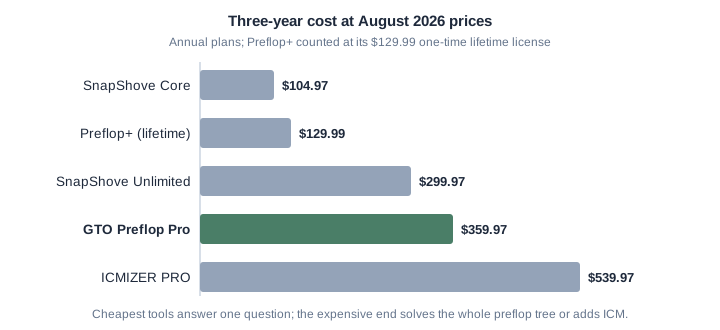
Annual plans, August 2026 prices, Preflop+ counted at its one-time lifetime license. SnapShove Core is the cheapest way to keep a Nash calculator in your pocket, and if that’s the whole job, $34.99 a year is fair. Apart from SnapShove Core, Preflop+ is the cheapest option on this chart.
GTO Preflop costs more over three years than SnapShove Unlimited, and the difference buys the part of preflop that jam-or-fold tools skip: the min-raise game from 10 big blinds up, 3-bet and facing-a-raise spots, cash and spin formats, and a trainer that tells you your actual EV loss instead of assuming you execute what you read. Upswing Poker calls playing too many hands preflop the number one leak among losing players. You make a preflop decision every hand; whether that’s worth $10 a month on the annual plan depends on how many of yours are still guesses.
What SnapShove still does well
Credit where it’s due:
- Arbitrary inputs, instantly. Enter any stack, any raise size, any opponent range and get the Nash answer on a phone. Nothing else here does custom-input jam math on mobile — ICMIZER does it on desktop.
- Reshove math specifically. Jamming over a raise is a spot charts handle badly, and SnapShove prices it directly.
- Free training simulations. Its site lists training as unlimited even on the free Starter plan.
- Core is cheap. $34.99 a year for unlimited shove calculations undercuts every subscription on this page.
If it answered anything above 8 big blinds and its current release were rated like its reputation, this article wouldn’t exist.
Which one should you pick?
- You grind turbos, hypers or live shootouts and want jam math only: SnapShove Core at $34.99/yr, or Preflop+ lifetime at $129.99 if you’d rather pay once and get drills.
- Bubbles and final tables are where your money is: ICMIZER 3. Nothing mobile replaces real ICM work.
- Spin & Gos are most of your volume: jam charts alone won’t cover it, because spins turn uneven after one pot. The best Spin & Go tools compares the options that solve asymmetric stacks.
- You’re spending nothing: a printable Nash chart plus SnapShove’s one free calculation a day.
- You want your whole preflop game solved and tested, not just the all-in: GTO Preflop. That’s the gap we built it to fill — push/fold is in there, and so is everything the solver does once shoving stops being the answer.
If you’re weighing chart apps more generally rather than push/fold specifically, our roundup of the best preflop chart apps covers seven of them with verified prices.
SnapShove alternatives: FAQ
Is SnapShove still free?
Partly. The Starter plan is free and includes one shove, call or reshove calculation per day plus unlimited training simulations, per SnapShove’s own site in August 2026. That daily solve is fully unlocked, so it can be a shove, a call or a reshove. Going past one a day requires Core at $3.99/mo or $34.99/yr, and unlimited calling and reshove modes need Unlimited at $9.99/mo or $99.99/yr.
At what stack depth does push/fold actually start?
Around 8 big blinds with antes, based on our solve database. In GTO Preflop’s MTT ChipEV solutions, every opening raise at 3–8 big blinds is all-in, but from 10 big blinds a 2bb min-raise sits in the tree alongside the jam, and 2bb is still the solved opening size at 20. Treating 15–20 big blinds as jam-or-fold territory gives up EV that a raise-capable strategy keeps.
Is there a push/fold chart app for iPhone?
Several. SnapShove computes Nash shoves for custom stacks, Preflop+ ships Nash charts from 5bb up with EV per hand, and GTO Preflop includes push/fold ranges inside its full preflop solution with a trainer that grades you. All three are free to download with paid tiers.
Does SnapShove use ICM?
Its ranges don’t. SnapShove states that its solutions are based on a ChipEV Nash equilibrium, which ignores payout structure. Its update notes mention an added ICM calculator for evaluating tournament equity, but the shove and call ranges themselves stay ChipEV. For ICM-adjusted ranges, use ICMIZER or HoldemResources Calculator.
Are free printable push/fold charts accurate?
The good ones are accurate for the exact scenario they solve, which is usually even stacks, one opponent and a stated (or unstated) ante. They drift from optimal in multiway pots, at asymmetric stacks and under different ante structures, and they can’t measure whether you actually apply them. Check the assumptions before memorizing one.
SnapShove vs GTO Preflop — which should I get?
If you want a calculator for arbitrary jam spots at the table, SnapShove’s custom inputs do something we don’t. If you want to study and train, GTO Preflop covers the push/fold depths (3–8bb solved as pure jam ranges), everything above them through 100bb, spins with asymmetric stacks, and a trainer that reports EV loss per 100 hands — for $119.99/yr standard.
Sources
- SnapShove on the App Store — 2.5/5 across 22 ratings, in-app purchase list, checked August 19, 2026
- SnapShove.com — Starter/Core/Unlimited tiers, one-calculation-per-day free limit, ChipEV Nash methodology, checked August 19, 2026
- Preflop+ on the App Store — $9.99/$79.99/$129.99 pricing, 4.6/5 rating, version 25.9 dated August 10, 2026; rating and update date re-checked September 1, 2026
- ICMIZER pricing — Basic and PRO tiers across all billing periods, checked August 18, 2026
- HoldemResources Calculator pricing — Classic and Pro tiers, checked August 18, 2026
- Upswing Poker: 3 poker tools for tournament players — SnapShove’s standing recommendation
- Upswing Poker: preflop mistakes to avoid — loose preflop play as the top leak among losing players
- GTO Preflop on the App Store — pricing, device support and the 4.8/240 rating, checked August 19, 2026
- Raise-size and coverage figures from GTO Preflop’s solve database (11,385 decision points, 503 scenarios); install figures from our own Apple Search Ads account, 30 days to August 11, 2026, attributed keyword installs only
All product names, logos and brands are property of their respective owners and are used for identification only. GTO Preflop is not affiliated with or endorsed by SnapShove, Crafty Wheel Studios, ICMIZER or HoldemResources. Prices verified August 18–19, 2026 — check each vendor’s listing for current rates.