
1. Introduction to GTO Poker in Multi-Table Tournaments
1.1 What is GTO poker?
GTO (Game Theory Optimal) poker is a strategy built to be unexploitable: it accepts a smaller edge against weak opponents in exchange for never handing a strong opponent a counter-strategy that beats it. In MTTs, GTO solutions give you a baseline for every stack depth and tournament stage, and a reference point you can deliberately deviate from once you know what an opponent is doing wrong.
1.2 The importance of adapting to stack sizes
Stack size is the single biggest structural variable in MTT strategy. As your stack moves, the correct range moves with it, and not always in the direction people assume. Adapting to different stack depths is what separates tournament players who survive the middle stages from those who bleed out in them. The GTO Preflop app solves preflop ranges at 14 separate depths from 3 to 100 big blinds, so you can see exactly how a spot changes as the stack drains.
1.3 Overview of MTT stages and corresponding stack sizes
MTTs typically progress through three main stages:
- Early stage: Deep stacks (100BB+)
- Middle stage: Medium stacks (30-50BB)
- Late stage: Short stacks (10-20BB)
Each stage requires different strategies, which we’ll explore in Chapter 2: Early Stage MTT Strategy, Chapter 3: Middle Stage MTT Strategy, and Chapter 4: Late Stage MTT Strategy.
Before any of that, it helps to see what the solver actually does as the stack changes. The chart below comes from our own solve database: the share of hands played from each seat when the action folds around to it, across all 14 solved MTT depths at an 8-max table with a 12.5% ante.
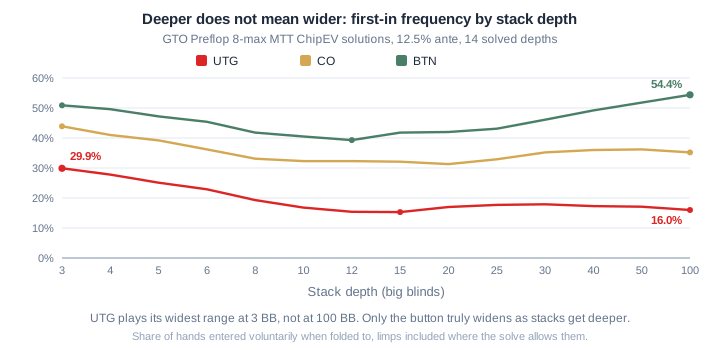
The pattern is not the one most stack-size guides describe. Under the gun, the solver plays its widest range at 3 big blinds (29.9%) and one of its tightest at 100 big blinds (16.0%). Only the button meaningfully widens as stacks get deeper, from 39.3% at 12 big blinds to 54.4% at 100. Everything in this guide follows from that shape.
Tip:
Understanding GTO principles is crucial, but don’t forget to balance it with exploitative play. Learn more about this in our post on Mastering GTO Poker: Balancing Bluffs and Value Bets.
2. Early Stage MTT Strategy: Deep Stack Play
2.1 Optimal opening ranges for deep stacks
Deep stacks do not mean loose stacks. At 100 big blinds the solver opens 16.0% under the gun and 18.6% from UTG+1 — tighter than the same seats play at 8 big blinds, where the ante is a bigger prize relative to the risk and every open is a jam. What stays wide at deep stacks is late position: 35.2% from the cutoff and 54.4% from the button, because deep stacks reward the player who gets to act last on every street after the flop.
The practical rule for early-stage play is therefore positional, not depth-based: open tight from early seats, take advantage of the button, and let the GTO Preflop app give you the exact range for the seat and depth you are sitting at.
2.2 3-betting and 4-betting strategies
With deep stacks, 3-betting and 4-betting become powerful tools. Use a mix of value hands and bluffs to keep opponents guessing. Consider pot odds and implied odds when deciding to 3-bet or 4-bet.
Tip:
Remember to adjust your 3-betting and 4-betting ranges based on your opponent’s tendencies. Balance is key in GTO play, but exploitative adjustments can be highly profitable.
2.3 Post-flop play with 100BB+
Deep stack post-flop play allows for more complex strategies:
- Utilize multi-street bluffs
- Play more draw-heavy hands
- Implement delayed c-bets on dry boards
- Use pot control with medium-strength hands
As the tournament progresses, you’ll need to adjust these strategies. We’ll cover this in Chapter 3: Middle Stage MTT Strategy.
Note:
Understanding pot odds is crucial for making profitable decisions in deep stack play. Learn more about this concept in our article on How to Calculate Pot Odds in Poker and Use Them Effectively.
3. Middle Stage MTT Strategy: Medium Stack Adjustments
3.1 Shifting gears as stacks get shallower
As the tournament progresses and stacks become shallower (30-50BB), players must adjust their strategy. This stage requires a more aggressive approach, with a focus on stealing blinds and antes. In the solves, the cutoff and button both open wider at 30 big blinds than at 15, because there is now enough behind to play a flop with and late position’s postflop edge starts to pay again. The GTO Preflop app can help you optimize your opening ranges for these stack depths.
3.2 Why push/fold does not belong here
A lot of tournament advice tells medium stacks to start thinking in jam-or-fold terms. Our solve database says otherwise. At 40 big blinds and above, the all-in has disappeared from every seat’s opening range — not under the gun, not on the button, not in the small blind, with every residual frequency below one open in ten thousand. At 30 big blinds the only seat still shoving at all is the small blind, on 5.0% of its opening raises; every other seat is under 0.01%.
What medium stacks actually need is the raise-size discipline that jam-or-fold thinking skips. Key factors to consider:
- Position
- Stack size relative to blinds and antes
- Opponents’ tendencies
- ICM implications
Tip:
Push/fold arrives later than most players expect. We map exactly where it starts in Chapter 4: Late Stage MTT Strategy.
3.3 Defending blinds with 30-50BB
Blind defense becomes crucial in the middle stages. With 30-50BB, you should:
- Defend wider against late position opens
- Use 3-bets to protect your blinds
- Consider stack-to-pot ratio when calling
Note:
Balancing your ranges is key in GTO play. Learn more about this concept in our article on Mastering GTO Poker: Balancing Bluffs and Value Bets.
4. Late Stage MTT Strategy: Short Stack Mastery
4.1 Where GTO push/fold charts actually apply
Push/fold is a real skill, and it covers a narrower band of stack depths than the apps built around it suggest. Here is the same solve database again, this time showing what share of each seat’s opening raises put the entire stack in:
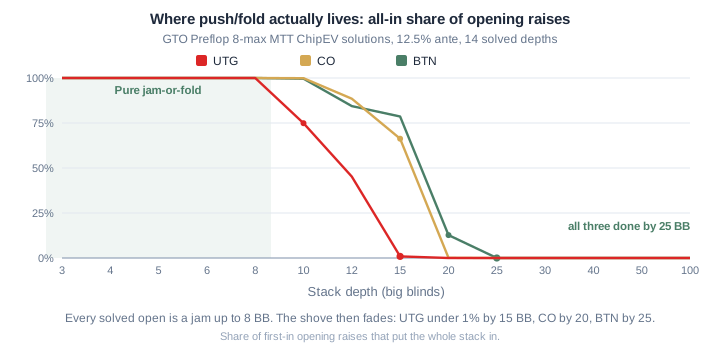
At 3 to 8 big blinds every solved opening raise is an all-in, from every seat. That is genuine push/fold poker, and a Nash chart answers it well. From 10 big blinds the solver already has a 2bb min-raise available and starts using it: under the gun, 74.9% of opens are jams at 10 big blinds, 45.2% at 12, and 0.9% at 15.
After that the shove fades in seat order, earliest first. At 15 big blinds the all-in share of opens rises steadily from the first seat to the button: 0.9% under the gun, 11.0% from UTG+1, 26.3% from LJ, 46.8% from HJ, 66.3% from the cutoff and 78.6% on the button. By 20 big blinds the first five of those are gone. The button holds on to 12.7% at 20 and has stopped by 25. The small blind is the last to let go: 41.3% at 20 big blinds, 20.8% at 25, 5.0% at 30, and gone by 40.
So the practical band is:
- 3-8BB: pure jam-or-fold, every seat
- 10-12BB: jams dominate but a min-raise exists and matters
- 15-20BB: the jam retreats fast — still live from every seat but under the gun at 15BB, down to the button and small blind by 20
- 25BB+: a raising game, with the small blind the last seat to give up the shove
The GTO Preflop app covers all of it, and its trainer deals MTT spots from 3 to 12 big blinds — the depths where the shove is in play on every hand — and grades every decision against the solution.
For a tool-by-tool comparison of dedicated push/fold apps, including where pure jam-or-fold play actually ends, see our SnapShove alternatives breakdown.
4.2 ICM considerations in late stages
Independent Chip Model (ICM) significantly impacts decision-making in late stages. Factors to consider:
- Pay jump proximity
- Stack sizes of other players
- Risk premium for tournament life
Tip:
ICM often dictates tighter play than ChipEV suggests. The charts above are ChipEV solutions, so treat them as the floor: near a pay jump the correct range is tighter than what they show.
4.3 Optimal calling ranges against short stack shoves
Defending against short stack shoves requires careful consideration:
- Adjust calling ranges based on shoving player’s range
- Factor in your stack size and position
- Consider tournament stage and ICM implications
Note:
Mastering short stack play is crucial for MTT success. Combine GTO principles with situational awareness for best results.
5. Final Table Dynamics: Mixed Stack Sizes
5.1 Adapting to varying stack depths at the final table
Final tables present unique challenges due to mixed stack sizes. The key is knowing which stacks are under ICM pressure and which are not:
- Short stacks have the least to lose and call the widest — apply pressure to them last
- Medium stacks are the ones a pay jump punishes, so they are the ones you attack
- Adjust opening ranges based on stack size dynamics
The GTO Preflop app can help optimize your ranges for various stack depths at the final table.
5.2 Leveraging stack size disparities
Exploit stack size differences:
- Apply pressure on medium stacks when you’re the chip leader
- Use ICM considerations to your advantage against shorter stacks
- Adjust your 3-betting strategy based on opponents’ stack sizes
Tip:
Remember, final table play requires a balance of GTO principles and exploitative adjustments. Don’t be afraid to deviate from GTO when you spot clear exploits.
5.3 Heads-up play adjustments based on stack sizes
Heads-up dynamics change dramatically based on stack sizes:
- Deep stacks: Employ a more aggressive, wide-ranging strategy
- Medium stacks: Focus on pot control and selective aggression
- Short stacks: Utilize push/fold strategies effectively
Note:
Mastering final table play is crucial for tournament success. Combine the strategies from Chapter 4: Late Stage MTT Strategy with these final table adjustments for optimal results.
6. Advanced GTO Concepts for MTTs
6.1 Balancing ranges across different stack sizes
Maintaining balanced ranges is crucial in GTO play, especially as stack sizes fluctuate in MTTs:
- Adjust your value-to-bluff ratio based on stack depth
- Incorporate mixed strategies for certain hands
- Use the GTO Preflop app to optimize preflop ranges for various stack sizes
6.2 Exploitative adjustments to complement GTO play
While GTO is unexploitable, incorporating exploitative elements can maximize profit:
- Identify player tendencies and adjust accordingly
- Over-fold against players who only put chips in with strong hands
- Against calling stations, do the opposite: value bet thinner and cut the bluffs, because they pay off the first and never fold to the second
- Gradually revert to GTO as opponents adjust
Tip:
Remember, the goal is to maximize EV. Sometimes, deviating from GTO is the most profitable play in specific situations.
6.3 Using solvers to improve stack-based decision making
Solvers are powerful tools for enhancing your GTO play in MTTs:
- Study solver solutions for various stack depths
- Analyze how optimal strategies change with stack size
- Create custom scenarios to improve decision-making in complex spots
Note:
While solvers are invaluable, don’t forget the importance of in-game adjustments. Balance solver study with practical application and review of your play.
As you master these advanced concepts, you’ll be better equipped to navigate the complex landscape of MTTs. In the next chapter, we’ll discuss common stack size mistakes to avoid, further refining your tournament strategy.
7. Common MTT Stack Size Mistakes to Avoid
7.1 Overplaying medium stacks
Many players make the mistake of playing too aggressively with medium stacks (30-50BB). Key points to remember:
- Avoid unnecessary risks when not short-stacked
- Balance aggression with pot control
- Use the GTO Preflop app to optimize your opening ranges for medium stacks
7.2 Mismanaging short stacks
Short stack play (10-20BB) is crucial in MTTs. Common mistakes include:
- Waiting too long to make moves
- Calling off too light against shoves
- Reaching for a jam at 20 big blinds from early or middle position, where the solver’s own answer is a 2bb min-raise
Tip:
Remember, short stack play often revolves around push/fold decisions. Study ICM implications to make better choices in these spots.
7.3 Failing to adjust to opponents’ stack sizes
Adapting to your opponents’ stack sizes is crucial for MTT success:
- Avoid bluffing into short stacks
- Be cautious when facing aggression from larger stacks
- Exploit medium stacks that are playing too cautiously
Note:
Stack awareness is a key skill in MTTs. Constantly monitor your own stack and those of your opponents to make optimal decisions.
By avoiding these common mistakes, you’ll significantly improve your MTT performance. In the next chapter, we’ll discuss practical tips for implementing stack-based GTO strategies in your game.
8. Practical Tips for Implementing Stack-Based GTO Strategies
8.1 In-game stack size tracking techniques
Effective stack size tracking is crucial for implementing GTO strategies:
- Use poker tracking software for online play
- Develop a quick mental math system for live games
- Regularly assess your stack relative to the blinds and antes
- Pay attention to significant stack changes at your table
8.2 Mental shortcuts for quick GTO approximations
While perfect GTO play is complex, these mental shortcuts can help:
- Memorize key push/fold ranges for common stack sizes
- Count your stack in big blinds before you look at your cards, so the depth decides the plan and the hand only fills it in
- Remember the two edges of the shoving band: at 8 big blinds and below every open is all-in, and by 40 no seat opens all-in at all
- Consider pot odds and implied odds for postflop decisions
Tip:
Practice these shortcuts off the table, in study sessions, so they are automatic by the time you are in a hand.
8.3 Utilizing tools and software for stack size analysis
Leverage technology to enhance your stack-based decision making:
- Use the GTO Preflop app for optimal preflop ranges based on stack size
- Employ ICM calculators for late-stage tournament decisions
- Analyze your play with poker tracking software and GTO solvers
- Practice with stack size-specific drills and quizzes
Note:
While tools are valuable, remember that real-world application and experience are equally important. Balance your study with actual gameplay to refine your skills.
By implementing these practical tips, you’ll be better equipped to apply GTO principles across various stack sizes in MTTs. In the next chapter, we’ll conclude our discussion on mastering stack-based GTO play in tournaments.
9. Conclusion: Mastering Stack-Based GTO Play in MTTs
9.1 Recap of key strategies
Throughout this guide, we’ve covered essential stack-based GTO strategies for MTTs:
- Early stage: tight early position, wide button, and the depth where late position pays best
- Middle stage: a raising game, not a shoving one, with blind stealing as the engine
- Late stage: real push/fold from 3 to 8 big blinds, mixed from 10 to 25, and to 30 in the small blind
- Final table: adapting to mixed stacks and pressuring the players ICM punishes
Remember, the GTO Preflop app is an invaluable tool for optimizing your preflop ranges across all stack depths.
9.2 The importance of continuous learning and adaptation
Mastering stack-based GTO play is an ongoing process:
- Regularly study and analyze your play
- Stay updated with evolving GTO strategies
- Practice implementing these concepts in real games
- Be prepared to adjust your strategy as the meta-game changes
Tip:
Combine your GTO knowledge with exploitative adjustments for maximum effectiveness. Balance is key in becoming a well-rounded MTT player.
9.3 Final thoughts on balancing GTO and exploitative play in MTTs
While GTO provides a solid foundation, remember:
- Pure GTO is often impractical in real-world scenarios
- Identify and exploit opponents’ tendencies when possible
- Use GTO as a baseline, but be willing to deviate for higher EV spots
- Continuously refine your understanding of both GTO and exploitative strategies
Note:
Success in MTTs comes from a combination of solid GTO fundamentals, adaptability, and the ability to read and exploit opponents. Keep refining your skills in all these areas.
By mastering stack-based GTO play and complementing it with smart exploitative adjustments, you’ll be well-equipped to navigate the complex world of MTTs and improve your long-term results. Remember to utilize tools like the GTO Preflop app to refine your preflop game, and never stop learning and adapting your strategy.