If you could change only one thing about your poker game and see immediate results, it would be this: start paying attention to position. Position is the single largest edge available in poker. It determines how wide you can open, how effectively you can bluff, and how much information you have when making critical decisions. In this guide, we break down all six positions at a 6-max table, explain the strategic logic behind each one, and give you actionable ranges you can take directly to the tables.
Why Position Is Your Biggest Edge
Position in poker refers to your seat relative to the dealer button and, more importantly, the order in which you act on each postflop street. The player who acts last has a massive structural advantage because they get to see what everyone else does before making their own decision.
This informational advantage compounds across every street. On the flop, turn, and river, the in-position player:
- Sees opponent actions first - A check from your opponent signals weakness; a bet signals strength (or a bluff). You get this information for free before committing chips.
- Controls the pot size - When in position, you can check back to keep the pot small with marginal hands, or bet to build it with strong ones. Out of position, you must act blind.
- Bluffs more effectively - When your opponent checks to you, you can bet as a bluff with much higher success rates because they have already shown weakness.
- Realizes equity better - Even with the same hand, the in-position player wins more money over time because they can make better-informed decisions on every street.
Note:
The Core Principle: In poker, information is money. Position gives you information that your opponents do not have. This is why GTO solvers assign significantly wider opening ranges to later positions - the positional advantage compensates for weaker card strength.
The 6 Positions Explained
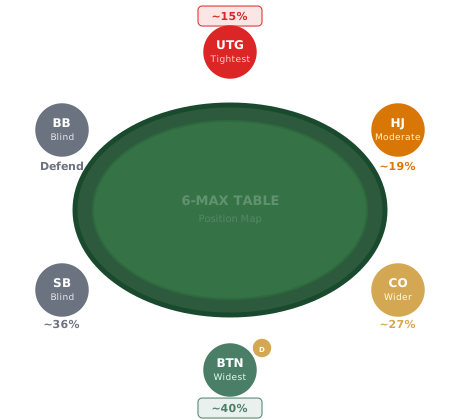
In a standard 6-max game (the most popular format in online poker and increasingly common live), there are six seats at the table. Each position has a distinct strategic profile. Let us walk through them clockwise from earliest to latest.
UTG (Under the Gun)
UTG is the first player to act preflop in a 6-max game (to the left of the Big Blind). This is the worst preflop position because five other players can act after you, and any of them might hold a monster. You will also be out of position against everyone except the blinds.
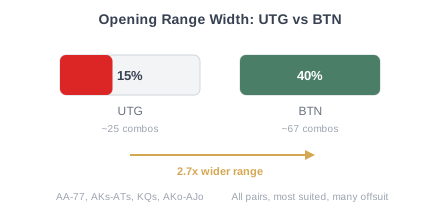
GTO opening range from UTG: approximately 15% of hands. This typically includes pocket pairs down to 66 or 77, suited broadways, AJo+, and a few premium suited connectors like T9s and 98s.
HJ (Hijack)
The Hijack sits one seat to the right of the Cutoff. With four players behind, you can open slightly wider than UTG. The HJ is often considered the beginning of “middle position” territory in modern 6-max strategy.
GTO opening range from HJ: approximately 19% of hands. You can add suited connectors down to 76s, all suited aces, and a few more offsuit broadways like KJo and QJo.
CO (Cutoff)
The Cutoff is one off the Button and is the first truly “late” position. With only the Button and blinds behind you, the odds of facing a 3-bet drop significantly. This allows for a meaningful widening of your opening range.
GTO opening range from CO: approximately 27% of hands. You can now open many suited one-gappers, more offsuit broadways, and hands like K9s, Q9s, and J9s that would be folded from earlier positions.
BTN (Button)
The Button is the most profitable seat at the poker table. Only the two blinds act after you preflop, and you are guaranteed position postflop against everyone still in the hand. This structural advantage is enormous.
GTO opening range from BTN: approximately 40% of hands or more. From the Button, you can profitably open hands like K5s, Q7s, J8s, T7s, 96s, 85s, and many offsuit broadways. The key insight is that you don’t need strong cards when you have the positional advantage - your ability to outplay opponents postflop compensates for weaker starting hands.
SB (Small Blind)
The Small Blind is a unique position. You have already invested half a big blind, which gives you a slight price discount. However, you will be out of position against every opponent for the entire hand - there is no seat you can act after. This positional disadvantage is severe.
Modern GTO strategy recommends a 3-bet or fold approach from the SB. Flat-calling creates a bloated pot where you are out of position with a capped range - a recipe for losing money. When you do enter the pot, 3-bet with roughly 36% of hands, choosing a polarized range of strong value hands and select bluffs.
BB (Big Blind)
The Big Blind is already invested one full blind, which means you get a significant discount to see flops. Against a standard 2.5BB open, you only need to call 1.5BB to see the flop, getting excellent pot odds. This is why GTO ranges defend the BB extremely wide.
BB defense ranges vary based on who opened and their sizing, but defending 40-55% of hands is common against single raises. The challenge is that you play the rest of the hand out of position, which means you need to be skilled at check-raising, donk-betting, and navigating multistreet decisions from a positional disadvantage.
Tip:
Pro Tip: The BB is the only position where flat-calling is standard strategy. In every other position, you should strongly prefer raising or folding to minimize the disadvantage of being out of position.
Early Position: Playing Tight
The fundamental principle of early position play is range quality over range quantity. When you open from UTG or HJ, your hands need to be strong enough to withstand 3-bets, play profitably from out of position, and hold up in multiway pots if several players call.
Why Tight is Right in EP
- More players behind you - With 4-5 players yet to act, the probability of running into a premium hand increases dramatically.
- 3-bet frequency - Late-position players will 3-bet you frequently because your tight range makes you a clear target when you show weakness.
- Positional disadvantage postflop - You will often be out of position, which means you need stronger starting cards to compensate.
EP Opening Range Principles
From UTG and HJ, your opening range should consist primarily of:
- All pocket pairs 77+ (some solvers include 66 and even 55 from HJ)
- Suited broadways: AKs, AQs, AJs, ATs, KQs, KJs, QJs
- Top offsuit hands: AKo, AQo, AJo (HJ can add KQo)
- Select suited connectors: T9s, 98s (these provide balance and playability)
Notice how the range is dominated by high-card hands with good equity. You are not opening many speculative hands from early position because you cannot rely on position to outplay opponents postflop.
Late Position: Where Profits Live
The Button and Cutoff are where skilled players generate the majority of their winnings. The combination of wider ranges and positional advantage creates a compounding edge that is difficult to overcome.
Button Strategy Deep Dive
From the Button, you should be opening aggressively. When it folds to you on the BTN, you are only facing the two blinds, and you will have position postflop against both of them. This is such a favorable situation that you can open hands like:
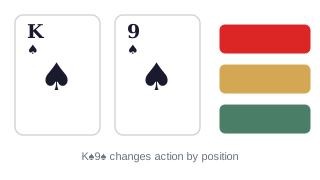
A hand like K♠9♠ perfectly illustrates the power of position. From UTG, this hand is a clear fold - it is too weak to withstand 3-bets and too difficult to play out of position. But from the Button, it is a profitable open that can make flushes, top pair, and has enough playability to navigate complex postflop situations with the advantage of acting last.
Cutoff Strategy
The Cutoff plays similarly to the Button but slightly tighter because the BTN can still act behind you. If the BTN is an aggressive 3-bettor, you may need to tighten your CO range. If the BTN is passive, you can open wider knowing you are likely to see a flop in position against the blinds.
Warning:
Common Mistake: Do not play the same range from the CO as you do from the BTN. The Button acting behind you has a significant impact on your expected value. The CO range should be roughly 60-70% as wide as your BTN range.
Blind Defense Strategy
The blinds are the two positions where you have already committed money to the pot. This forced investment changes your strategy significantly compared to other positions.
Big Blind Defense
The BB is the most important defensive position because of the price you are getting. Against a 2.5BB open from the BTN, you only need to call 1.5BB into a pot that will be 5.5BB. This means you need just 27% equity to break even on a call - and most hands have that against a wide BTN opening range.
Key principles for BB defense:
- Defend wider against late position opens - A BTN open is much weaker than a UTG open. Adjust your defense accordingly.
- 3-bet for value and as a bluff - Mix in 3-bets with your best hands (value) and selected blockers like A5s, A4s (bluffs). Learn more about constructing your 3-bet ranges.
- Flat-call with hands that play well postflop - Suited connectors, small pairs, and suited aces are great flat-calling hands because of their implied odds.
- Fold hands with poor playability - Despite the price, hands like Q3o, J4o, and 72o are still unprofitable calls because they make too many weak hands postflop.
Small Blind Strategy
As mentioned, the SB should adopt a primarily 3-bet or fold strategy. When everyone folds to you in the SB, you can open wider (around 36% of hands) because you only face one opponent. But when someone has already opened, your options narrow to 3-betting or folding.
The reason is straightforward: flat-calling from the SB puts you in the worst possible postflop situation. You are out of position, your range is capped (you would have 3-bet your strong hands), and your opponent knows this. Every skilled player will exploit a SB who flat-calls too often.
Putting Position Into Practice
Understanding position conceptually is the easy part. The challenge is consistently making correct positional adjustments under the pressure of real play. Here is a framework to accelerate your learning:
- Start with opening ranges - Memorize a solid opening range for each position. Use the starting hands chart as your foundation.
- Track your results by position - Use a HUD or manual tracking to see your win rate from each seat. If you are losing from EP but winning from LP, your ranges are likely close to correct. If you are losing everywhere, you may be playing too many hands.
- Pay attention to postflop advantages - Notice how much easier decisions are when you act last. This experience will reinforce why position matters so much.
- Adjust to opponents - If the players to your left are aggressive 3-bettors, tighten your late position opens. If they are passive, widen them. Position strategy is not static - it adapts to the table. See our article on exploiting GTO deviations for more on adaptive play.
Train Position Play with GTO Preflop
The fastest way to internalize position-based preflop strategy is through repetition against solver-approved ranges. GTO Preflop is built specifically for this purpose.
Note:
How GTO Preflop Trains Positional Play:
- Randomized scenarios from every position at the table
- Practice opening, 3-betting, and defending ranges by position
- Instant feedback showing the GTO-correct action for every hand/position combination
- ELO rating system that tracks your improvement over time
- Detailed error analysis highlighting your positional leaks
Most players overestimate how well they adjust by position. They know conceptually that the Button should open wider, but under time pressure they either play too tight (leaving money on the table) or too loose (spewing chips). Deliberate practice with a tool like GTO Preflop bridges the gap between knowing and doing.
Position is not just one factor among many - it is the lens through which every other preflop decision should be viewed. Master it, and you have mastered the foundation of winning poker.
Ready to sharpen your positional game? Try GTO Preflop free today and start training the skill that separates winning players from the rest.