
The 3-bet is one of the most powerful weapons in your preflop arsenal. Used correctly, it builds bigger pots with your best hands, pressures opponents into folding, and establishes an aggressive table image that makes you harder to play against. Yet many players either 3-bet too rarely (missing value and allowing opponents to see cheap flops) or too often with the wrong hands (burning money against strong ranges). This guide covers everything you need to know about constructing balanced, GTO-approved 3-bet ranges.
What Is a 3-Bet?
In poker terminology, the “bet” sequence goes like this:
- 1-bet: The blinds (forced bets posted before cards are dealt)
- 2-bet (open raise): The first voluntary raise preflop
- 3-bet (re-raise): A raise on top of the open raise
- 4-bet: A raise on top of the 3-bet
- 5-bet: Typically an all-in shove
When someone opens to 2.5 big blinds and you raise to 7.5 big blinds, you have 3-bet. The 3-bet is critical because it accomplishes several strategic goals simultaneously:
- Isolates the opener - Other players behind you are far less likely to call a 3-bet than a single raise, allowing you to play heads-up.
- Builds the pot with strong hands - When you have AA or KK, you want as much money in the pot preflop as possible.
- Gains fold equity - Many opening hands cannot profitably continue against a 3-bet. You win the pot immediately a significant portion of the time.
- Balances your range - Without 3-bet bluffs, your opponents would know you always have a premium hand when you 3-bet, making you easy to play against.
Note:
Key Stat: In a typical 6-max game, players 3-bet between 7-10% of the time overall. However, this number varies dramatically by position - you might 3-bet 4% from the HJ but 12% from the BTN.
Polarized vs Merged 3-Bet Ranges
There are two fundamental approaches to constructing a 3-bet range, and understanding when to use each is essential for GTO play.
Polarized 3-Betting
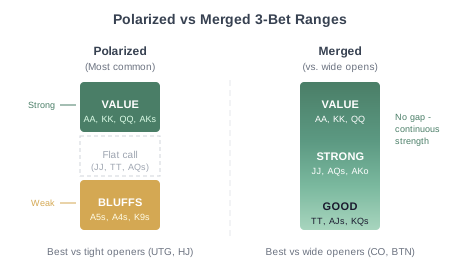
A polarized 3-bet range consists of two groups with a gap in the middle:
- Value hands at the top (AA, KK, QQ, AKs, and sometimes JJ, AKo)
- Bluff hands at the bottom (typically suited aces like A5s-A2s, or suited connectors like 76s, 87s)
- The middle (hands like TT, AQs, AJs, KQs) gets flat-called instead of 3-bet
This is the default 3-bet strategy used in most GTO solutions and is most effective against tight opening ranges (such as UTG or HJ opens). The logic is straightforward: against a tight range, your medium-strength hands perform better as calls (they have good equity and playability) while your bluffs use the fold equity of a 3-bet to profit even when they don’t have strong raw equity.
Merged 3-Betting
A merged 3-bet range has no gap - it includes your strongest hands and continues downward through good-but-not-premium hands, with no bluffs at the bottom:
- AA, KK, QQ, JJ, AKs, AKo (premium)
- AQs, AQo, AJs, KQs, TT (strong)
- ATs, KJs, 99 (solid)
Merged ranges are used against wide opening ranges (particularly BTN opens) or against opponents who do not fold to 3-bets often enough. When someone opens wide, your medium-strength hands gain enough equity to 3-bet for value directly, making the polarized gap unnecessary.
Tip:
Pro Tip: Against a recreational player who opens too wide and calls too many 3-bets, a merged range is almost always superior. Drop the bluffs and 3-bet the whole strong band listed above for pure value. Save polarized ranges for skilled opponents who are capable of folding and adjusting.
GTO 3-Bet Ranges by Position
Your 3-bet range should change based on two factors: who opened and where you are sitting. Understanding the interaction between these variables is key to constructing balanced ranges. For more on how position shapes every preflop decision, see our position strategy guide.
3-Betting In Position (IP)
When you are in position relative to the opener (e.g., you are on the BTN and HJ opens), your 3-bet range can be wider and more aggressive. Being in position postflop means:
- You realize more equity with your hands
- Your bluffs succeed more often (you can barrel effectively)
- Your value hands extract more money
Example: BTN 3-bet vs HJ open
- Value: AA, KK, QQ, JJ, AKs, AKo, AQs
- Bluffs: A5s, A4s, A3s, A2s, K9s, Q9s, 76s, 65s, 54s
- Typical range size: ~10-12% of hands
3-Betting Out of Position (OOP)
When you are out of position (e.g., you are in the BB and CO opens), your 3-bet range should be tighter and more value-heavy. The positional disadvantage means your bluffs succeed less often and your marginal hands play worse. You compensate by using larger sizing (more on this below).
Example: BB 3-bet vs CO open
- Value: AA, KK, QQ, AKs, AKo, JJ (sometimes AQs)
- Bluffs: A5s, A4s, K9s, Q9s, J9s, T9s, 87s
- Typical range size: ~8-10% of hands
Note:
Important: These ranges are approximate and vary based on stack depth, specific solver configurations, and the opponent’s opening range. The hands listed are the backbone of each range rather than a complete enumeration - solvers mix in further combos at low frequency. Use them as starting points and refine with practice.
Choosing 3-Bet Bluffs
Selecting the right bluffing hands is where 3-bet strategy gets nuanced. Not all unprofitable calling hands make good 3-bet bluffs. The ideal 3-bet bluff has several properties:
Blocker Value
Hands that contain an Ace or King block your opponent from holding the strongest hands. When you 3-bet with A5s, you reduce the probability that your opponent has AA, AK, or AQ - the hands most likely to 4-bet you. This blocker effect is subtle but mathematically significant over thousands of hands.
Postflop Playability
When your 3-bet bluff gets called, you need the hand to have some ability to improve. Suited hands are preferred because they can flop flush draws, giving you semi-bluffing opportunities on the flop and turn. Hands with connected ranks can also flop straight draws.
Best 3-Bet Bluffing Hands
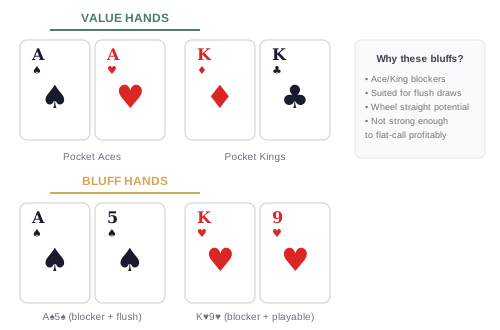
Based on GTO solver outputs, the most commonly selected 3-bet bluffs include:
- Suited wheel aces (A5s-A2s): These are the gold standard of 3-bet bluffs. They block AA and AK, can make the nut flush, and have wheel straight potential. A5s is the pick of the group because the 5 plays in five different straights while the 2 plays in only two, so it connects with far more boards when the 3-bet gets called.
- Suited kings (K9s-K5s): King blockers reduce the likelihood of facing KK and AK. These hands also have flush potential and some straight connectivity.
- Suited connectors (76s, 87s, 65s, 54s): These hands have excellent postflop playability when called. They can flop open-ended straight draws, flush draws, and two-pair combinations that play well in 3-bet pots.
- Suited one-gappers (T8s, 97s, 86s): Similar to suited connectors but with slightly less connectivity. Used to fill out the bluffing portion of your range.
Warning:
Warning: Avoid 3-bet bluffing with offsuit hands. Hands like K9o or Q8o make terrible 3-bet bluffs because they lack flush potential and are often dominated when called. Treat suitedness as a requirement for your 3-bet bluffs, not a bonus.
3-Bet Sizing
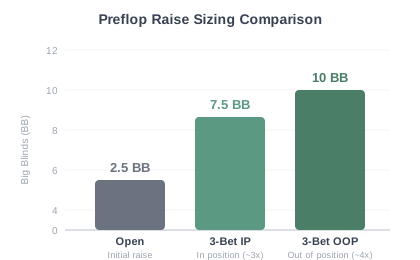
Your 3-bet sizing communicates information to your opponent and determines the pot geometry for the rest of the hand. GTO principles recommend different sizing based on your position relative to the opener.
In Position: 3x the Open Raise
When you 3-bet in position, a sizing of approximately 3 times the open raise is standard. If the opponent opens to 2.5BB, you 3-bet to 7-8BB. The smaller sizing works because:
- You will have position postflop, so a higher stack-to-pot ratio works in your favour
- Smaller sizing risks less with your bluffs while still building the pot with your value hands
- Position lets you realize more equity in the hands that do call, so you do not need to force as many folds preflop
Out of Position: 4x the Open Raise
When 3-betting from out of position (such as from the BB or SB), use a larger sizing of approximately 4 times the open raise. Against a 2.5BB open, this means 3-betting to 10-11BB. The larger sizing compensates for your positional disadvantage by:
- Reducing the stack-to-pot ratio, making postflop decisions simpler
- Giving your opponent worse pot odds to call, increasing fold equity
- Building a pot where you can more easily commit on later streets with strong hands
Tip:
Pro Tip: Use the same sizing for both your value hands and your bluffs. If you 3-bet to 10BB with AA but only 7.5BB with A5s, observant opponents will notice the pattern and exploit you. Consistent sizing keeps your range balanced and unreadable.
Responding to 4-Bets
When you 3-bet and face a 4-bet, you need a clear plan. Freezing up or making ad-hoc decisions leads to costly mistakes. Here is how GTO approaches 4-bet defense.
Continue with the Top of Your Range
Against a standard 4-bet, you should continue with approximately 30-40% of your 3-bet range. The specific hands depend on stack depth and the 4-bettor’s range, but general guidelines include:
- Always continue: AA, KK (5-bet all-in or call)
- Usually continue: QQ, AKs (call or 5-bet depending on position and stack depth)
- Sometimes continue: JJ, AKo (position-dependent; often a call IP, fold OOP against tight 4-bettors)
- Fold: Most 3-bet bluffs (76s, 65s, etc.) unless you have specific reads that the 4-bet is very wide
The 5-Bet Shove
With 100BB effective stacks, a 5-bet is almost always an all-in commitment. Your 5-bet range should be tight and primarily for value: AA and KK are always 5-bet shoves. QQ and AKs are sometimes included depending on the dynamics. Adding a 5-bet bluff with a hand like A5s can be appropriate at higher-level play, but at most stakes, keeping your 5-bet range pure value is the highest-EV approach.
When to Just Call a 4-Bet
Calling (rather than 5-betting) is appropriate when:
- You have position and a hand that plays well postflop (QQ, JJ, AKs)
- Stacks are deep enough that you are not pot-committed
- Your opponent’s 4-bet range is polarized, meaning they will fold bluffs to a 5-bet anyway
Calling keeps your opponent’s bluffs in the pot while maintaining the flexibility to play postflop. If you only 5-bet shove, you fold out all the bluffs and only get action from hands that crush you (AA, KK).
Common 3-Bet Mistakes to Avoid
Even players who understand the theory often make implementation errors. Watch out for these common pitfalls:
- Only 3-betting for value: If you never bluff with your 3-bets, opponents will simply fold everything except premiums, and you will never get paid off. Balance is essential.
- 3-betting the wrong bluffs: Using hands like KJo or QTo as 3-bet bluffs is a common mistake. They are dominated by most of the range that continues against a 3-bet, and with no flush potential to fall back on they flop far too little to barrel with. Stick to suited hands with blockers.
- Ignoring position when sizing: Using the same 3-bet size IP and OOP is a leak. Adjust your sizing based on position as described above.
- Not adjusting to stack depth: At 40BB effective stacks (common in tournaments), 3-betting can quickly become an all-in decision. Adjust your ranges accordingly - you need hands with strong all-in equity, not hands that rely on postflop playability. See our MTT stack size guide for more.
- 3-betting too wide against UTG opens: A UTG opening range is tight and strong. Your 3-bet bluffs have much less fold equity against this range. Reduce your bluffing frequency significantly against early position opens.
Practice 3-Betting with GTO Preflop
The 3-bet is one of the most frequently tested scenarios in the GTO Preflop training app. Knowing which hands to 3-bet, from which positions, and with what sizing is a skill that requires consistent practice to internalize.
Note:
Train Your 3-Bet Game:
- Face realistic 3-bet scenarios from every position
- Learn optimal 3-bet, call, and fold decisions against different openers
- Practice defending against 4-bets with solver-approved ranges
- Track your ELO rating as your 3-betting accuracy improves
- Review detailed hand analysis to identify leaks in your 3-bet strategy
The 3-bet is a skill that separates competent players from winning players. A well-constructed 3-bet range applies maximum pressure, builds profitable pot sizes, and keeps opponents guessing. Combined with a solid understanding of starting hand selection and positional awareness, mastering the 3-bet will elevate your preflop game to a professional level.
Ready to master the 3-bet? Try GTO Preflop free today and start training with solver-approved 3-bet ranges for every position and scenario.