Understanding which hands to play preflop is the single most impactful skill you can develop as a poker player. Every session, every tournament, every cash game begins with the same fundamental question: should I play this hand? A solid grasp of starting hand rankings will save you from costly mistakes and set the foundation for profitable poker. In this guide, we break down all 169 unique starting hands, rank them into clear tiers, and show you how position changes everything.
The 169 Unique Starting Hands
A standard 52-card deck produces 1,326 possible two-card combinations. However, because suits are interchangeable in terms of absolute hand strength preflop, these 1,326 combinations reduce to just 169 strategically unique starting hands. These hands are traditionally displayed in a 13x13 grid known as the hand matrix.
Reading the Hand Matrix
The hand matrix is organized with a clear logic:
- The diagonal (top-left to bottom-right) contains all 13 pocket pairs: AA, KK, QQ, JJ, TT, 99, 88, 77, 66, 55, 44, 33, 22.
- Above the diagonal (upper-right triangle) are all suited hands, marked with an “s” suffix (e.g., AKs means Ace-King suited).
- Below the diagonal (lower-left triangle) are all offsuit hands, marked with an “o” suffix (e.g., AKo means Ace-King offsuit).
Suited hands have roughly 3-4% more equity than their offsuit counterparts because of their ability to make flushes. This difference is meaningful but often overestimated by beginners.
Tip:
Pro Tip: The hand matrix is the most important tool in any preflop player’s arsenal. Memorizing which cells fall into which tier will dramatically speed up your decision-making at the table.
Complete 13x13 Hand Matrix
Below is the full starting hand matrix, color-coded by hand strength tier. Green cells are premium hands you should almost always play, light green are strong hands, gold are playable in the right spots, and gray hands are typically folds.
| AA | AKs | AQs | AJs | ATs | A9s | A8s | A7s | A6s | A5s | A4s | A3s | A2s |
| AKo | KK | KQs | KJs | KTs | K9s | K8s | K7s | K6s | K5s | K4s | K3s | K2s |
| AQo | KQo | QJs | QTs | Q9s | Q8s | Q7s | Q6s | Q5s | Q4s | Q3s | Q2s | |
| AJo | KJo | QJo | JJ | JTs | J9s | J8s | J7s | J6s | J5s | J4s | J3s | J2s |
| ATo | KTo | QTo | JTo | TT | T9s | T8s | T7s | T6s | T5s | T4s | T3s | T2s |
| A9o | K9o | Q9o | J9o | T9o | 99 | 98s | 97s | 96s | 95s | 94s | 93s | 92s |
| A8o | K8o | Q8o | J8o | T8o | 98o | 88 | 87s | 86s | 85s | 84s | 83s | 82s |
| A7o | K7o | Q7o | J7o | T7o | 97o | 87o | 77 | 76s | 75s | 74s | 73s | 72s |
| A6o | K6o | Q6o | J6o | T6o | 96o | 86o | 76o | 66 | 65s | 64s | 63s | 62s |
| A5o | K5o | Q5o | J5o | T5o | 95o | 85o | 75o | 65o | 55 | 54s | 53s | 52s |
| A4o | K4o | Q4o | J4o | T4o | 94o | 84o | 74o | 64o | 54o | 44 | 43s | 42s |
| A3o | K3o | Q3o | J3o | T3o | 93o | 83o | 73o | 63o | 53o | 43o | 33 | 32s |
| A2o | K2o | Q2o | J2o | T2o | 92o | 82o | 72o | 62o | 52o | 42o | 32o | 22 |
Premium Strong Playable Marginal / Fold
Hand Tier Rankings
Not all starting hands are created equal. GTO solvers and decades of poker theory have established a clear hierarchy. Understanding these tiers allows you to make fast, accurate preflop decisions without needing to consult a chart every hand.
Tier 1: Premium Hands
These are the hands you dream about. They are profitable from every position and should almost always be played aggressively:
- AA (Pocket Aces) - The best starting hand in poker. ~85% equity heads-up against a random hand.
- KK (Pocket Kings) - Second best. Only loses to AA preflop. ~82% equity vs. random.
- QQ (Pocket Queens) - Extremely strong but requires more careful postflop navigation.
- JJ (Pocket Jacks) - Often misplayed, but still a premium hand with ~77% equity vs. random.
- AKs (Ace-King suited) - The best non-pair hand. Great playability with flush and straight potential.
- AKo (Ace-King offsuit) - Slightly weaker than AKs but still a premium raising hand.
- AQs (Ace-Queen suited) - Strong enough to play from any position, great 3-bet candidate.
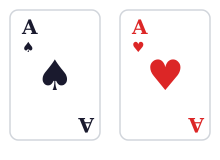
Pocket Aces (AA) - the best starting hand in poker
Note:
Key Insight: Premium hands represent only about 2.6% of all hands dealt. Patience is essential - you will not be dealt these hands often, but when you are, you should maximize value.
Tier 2: Strong Hands
These hands are strong enough to open-raise from most positions and are frequently used in 3-bet pots:
- TT, 99 - Medium pocket pairs with good equity but tough postflop spots on high boards.
- AJs, ATs - Strong suited aces with straight and flush potential.
- KQs, KJs - Broadway suited hands that connect well with flops.
- AQo - The best offsuit non-pair hand after AKo.
Tier 3: Playable Hands
These hands become profitable in the right conditions - typically from late position or in single-raised pots:
- 88, 77, 66 - Small-medium pocket pairs. Profitable for set-mining when deep-stacked.
- Suited connectors (T9s, 98s, 87s, 76s, 65s, 54s) - Excellent playability with straight and flush draws.
- Suited aces (A9s-A2s) - Nut flush potential makes these valuable bluffing and semi-bluffing hands.
- Suited broadway (QJs, QTs, JTs) - Good postflop playability from position.
Tier 4: Marginal / Fold
These hands are generally unprofitable to play. Even from late position, most of these should be folded unless you have a specific exploitative reason to play them:
- Low offsuit hands - Q7o, J6o, T4o, and worse. These hands rarely make strong hands postflop.
- Disconnected suited hands - K3s, Q4s, J5s. Being suited is not enough when the hand has no other redeeming quality.
- Weak offsuit aces - A8o and below are dominated too frequently to play profitably.
How Position Affects Starting Hands
Position is the single most important factor in determining which starting hands to play. The same hand can be a clear fold in one seat and a profitable open in another. For a deep dive into positional play, check out our complete position strategy guide.
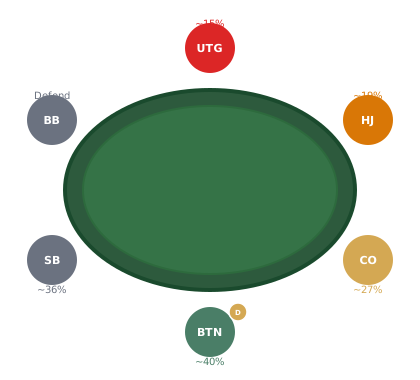
6-max table positions with approximate open-raising range widths
Early Position (UTG)
Under the Gun is the tightest position at the table. You act first preflop (after the blinds) and will be out of position against most callers. GTO solvers recommend opening only about 15% of hands from UTG in a 6-max game. This means sticking almost exclusively to Tier 1 and Tier 2 hands, plus the strongest Tier 3 hands like 88 and ATs.
Middle Position (HJ)
The Hijack opens slightly wider at around 19% of hands. You can add a few more suited connectors and broadways, but you still need to be selective because three players behind you can wake up with a strong hand.
Late Position (CO and BTN)
This is where profits are made. The Cutoff opens roughly 27% of hands, while the Button can open as wide as 40% or more. From the Button, you are guaranteed positional advantage postflop against the blinds, which means hands like K9s, Q9s, J8s, and small suited connectors become profitable opens.
The Blinds (SB and BB)
The Small Blind has a unique challenge: you have invested half a big blind but will be out of position postflop. The SB either 3-bets or folds in most GTO strategies, rarely flat-calling. The Big Blind defends wide because of the discount - you only need to call the difference between your posted blind and the raise. BB defense ranges often reach 40-50% of hands against a minimum raise.
Warning:
Warning: Never use a fixed starting hand chart without adjusting for position. Playing K9o from UTG the same way you would from the BTN is one of the fastest ways to lose money at the table.
Common Mistakes with Starting Hands
Even experienced players fall into traps when selecting starting hands. Here are the most costly errors and how to avoid them.
Mistake 1: Overvaluing Suited Hands
Yes, suited hands are better than their offsuit counterparts. But being suited only adds about 3-4% raw equity. The real value of suitedness comes from playability - you can continue on flush draw boards and occasionally win big pots. However, a hand like J4s is still terrible. Being suited does not rescue fundamentally weak card combinations.
Mistake 2: Playing Too Many Hands from Early Position
The temptation to “get involved” is strong, especially during a card-dead stretch. But playing hands like KTo or QJo from UTG puts you in dominated situations far too often. Remember: tight is right in early position. Your edge comes from playing strong ranges when acting first.
Mistake 3: Ignoring the Gap Concept
The gap concept states that you need a stronger hand to call a raise than to make one. If UTG opens and you are in the HJ with KJo, you should fold even though you might open that hand yourself from the HJ. The opener’s range is much stronger than an empty pot would require, so your calling range must be tighter.
Mistake 4: Not Adjusting to Table Dynamics
While GTO provides the foundation, you should adjust your starting hand selection based on your opponents. Against extremely tight players, you can steal more from late position. Against maniacs who 3-bet frequently, tighten your opening range and prepare to 4-bet or trap with premiums. For more on exploitative adjustments, see our guide on exploiting GTO deviations.
Mistake 5: Flat-Calling Too Often from the Small Blind
Modern GTO theory strongly discourages flat-calling from the Small Blind. When you call from the SB, you play the rest of the hand out of position in a bloated pot with a capped range. Instead, adopt a 3-bet-or-fold strategy from the SB. This simplifies your decisions and puts maximum pressure on the opener.
Tip:
Pro Tip: If you are unsure whether to play a hand, err on the side of folding. The money you save by avoiding marginal spots adds up far more than the small profits from playing borderline hands.
Beyond the Chart: When to Deviate
Starting hand charts are training wheels, not permanent fixtures. As you internalize GTO ranges, you will begin to make adjustments based on:
- Stack depth: Deep-stacked play favors suited connectors and small pairs (implied odds). Short-stacked play favors high-card hands (showdown equity). See our stack size adjustment guide for tournament applications.
- Opponent tendencies: Against a player who folds to raises 80% of the time, you can profitably open any two cards from late position.
- Table dynamics: If the table is playing extremely tight, widen your ranges. If players are 3-betting aggressively, tighten up and add more trapping hands.
- ICM considerations: In tournaments near the bubble or final table, starting hand requirements change dramatically based on payout implications.
Practice with GTO Preflop
Reading about starting hands is one thing; building the instinct to play them correctly under pressure is another. The fastest way to internalize these ranges is through deliberate practice.
GTO Preflop is a training app designed specifically for this purpose. It presents you with preflop scenarios across every position and stack depth, then grades your decisions against solver-approved GTO ranges. Over time, you build muscle memory so that correct starting hand decisions become automatic.
Note:
Key Features:
- Practice opening ranges for all 6 positions
- Train 3-bet, 4-bet, and squeeze scenarios
- Track your progress with an ELO rating system
- Review your mistakes with detailed hand analysis
Whether you are a beginner memorizing your first hand chart or an experienced player refining solver-approved ranges, mastering starting hand selection is the foundation of profitable poker. Start with the premium hands, expand your ranges as you move toward the button, and never stop adjusting based on your opponents and situation.
Ready to put your knowledge to the test? Try GTO Preflop free today and start training the preflop decisions that matter most.