The short answer
A multiway preflop pot is one where two or more opponents have already put money in voluntarily before the action reaches you. Ordinary preflop charts don’t cover it. They put you against at most one opponent, and the moment a second one enters, the range you memorized describes a hand that is no longer being played. GTO Preflop’s Multiway tab loads a separate solve tree: you set what each seat did, and it draws the range for that exact sequence.
It’s a lookup tool, not a drill. That distinction runs through the rest of this article.
For a worked tournament example, our JTs squeeze-jam study compares 60 open-and-call spots across stack depths and positions, including the early-position cases where the shove fails.
Note:
Full disclosure: GTO Preflop is our app. Every number about our app was either read off a store listing on August 22, 2026, or computed directly from the solve files it ships; rival figures come from the vendors’ own pages linked in the sources. Where a rival does something we don’t, it’s on the page.
Your chart library is a two-player library
I counted this rather than guessed it. GTO Preflop ships 503 pre-solved range files on the device, holding 11,385 distinct decision points between them. For each one I read the action sequence stored with the node and counted how many opponents had voluntarily put chips in before the hero’s turn.
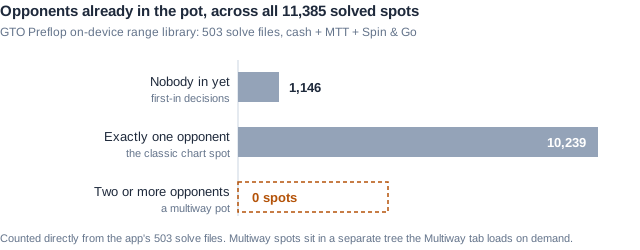
1,146 of those spots are first-in decisions, where nobody has entered yet. The other 10,239 face exactly one opponent. Not a single one of the 11,385 describes a pot with two opponents already in it.
That isn’t sloppiness, and it isn’t specific to us. A pre-solved library has to enumerate every action sequence it wants to answer, and sequences multiply fast: seven players each choosing fold, call or raise before you act is a far bigger tree than a table where the first raise ends the enumeration. Keeping the two-player tree on the phone is what makes a tap-fast lookup possible at all. Multiway lives somewhere else: a separate tree the app pulls down when you open the Multiway tab.
Worth saying plainly: if you use any pre-solved preflop chart, on paper or in an app, this limit is probably in it too. It’s rarely mentioned.
How often does solved play actually build a multiway pot?
Less often than you’d think, which is the interesting part.
Here is the app’s own solve for one specific spot: 8-max cash, 100 big blinds, 5% rake capped at 4bb, the lojack opening to 2.5bb. For each seat behind, this is the share of all starting hands that cold-calls versus 3-bets.
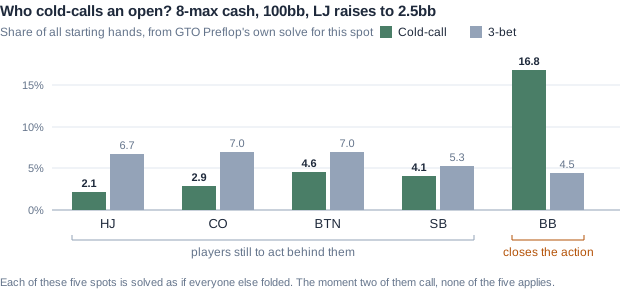
The four seats with players still to act behind them cold-call between 2.1% and 4.6% of hands. They 3-bet more often than they call. The big blind calls 16.8%, but the big blind closes the action, so its call makes the pot heads-up, not multiway.
So a table of solvers barely ever creates a multiway preflop pot on purpose. Yours does, constantly, because playing too many hands preflop is the single most common leak among losing players, and the shape that leak takes is a cold call. Every one of those calls drops you into a node your chart has never seen. Our post on exploiting deviations from GTO covers the wider version of that idea.
There’s a second route in that the numbers above hide. Once the button flats, the small blind and big blind are no longer facing a lone raiser. They’re facing a raise and a call. The app’s “big blind versus a lojack open” solve assumes everyone between folded. It has nothing to say about that spot.
Reading a multiway spot, step by step
Step 1: start from the two-player range
Open the Ranges tab and pick your seat, the opponent’s seat and the stack depth. This is the baseline, and it’s what most people mean by “the chart”.
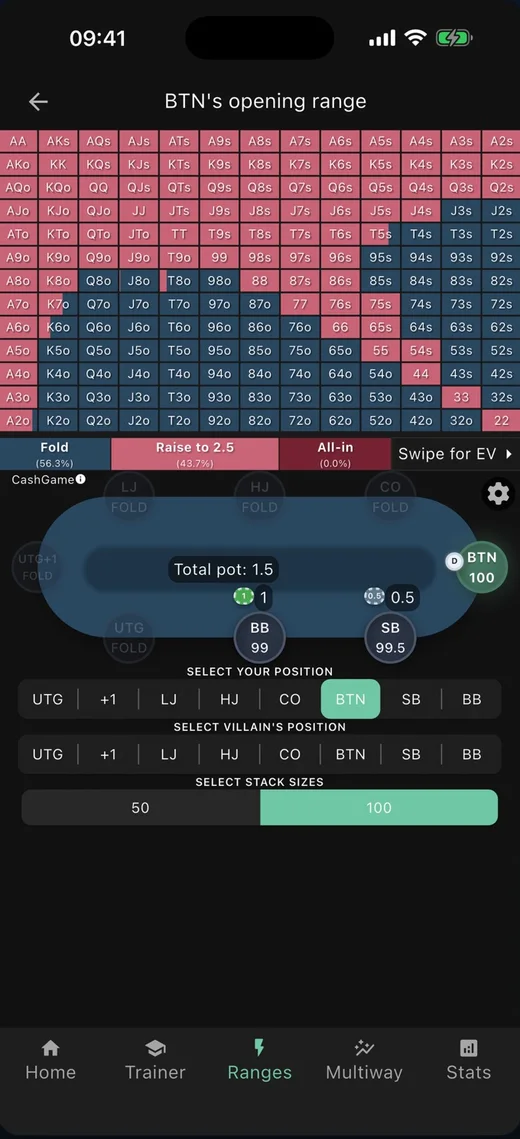
That’s the button’s first-in range in an 8-max cash game at 100bb: raise to 2.5bb with 43.7% of hands, fold 56.3%, never jam. The header strip under the matrix always carries the aggregate frequencies, and the whole 13x13 grid is colored by action.
The same file gives the rest of the ladder, if you want to check your own memory against it. First-in raising frequency at 8-max 100bb runs 13.9% from UTG, 15.8% from UTG+1, 18.1% from the lojack, 22.2% from the hijack, 29.2% from the cutoff and 43.7% on the button. Those are the numbers the app draws, straight out of the solve.
Step 2: rebuild the sequence in the Multiway tab
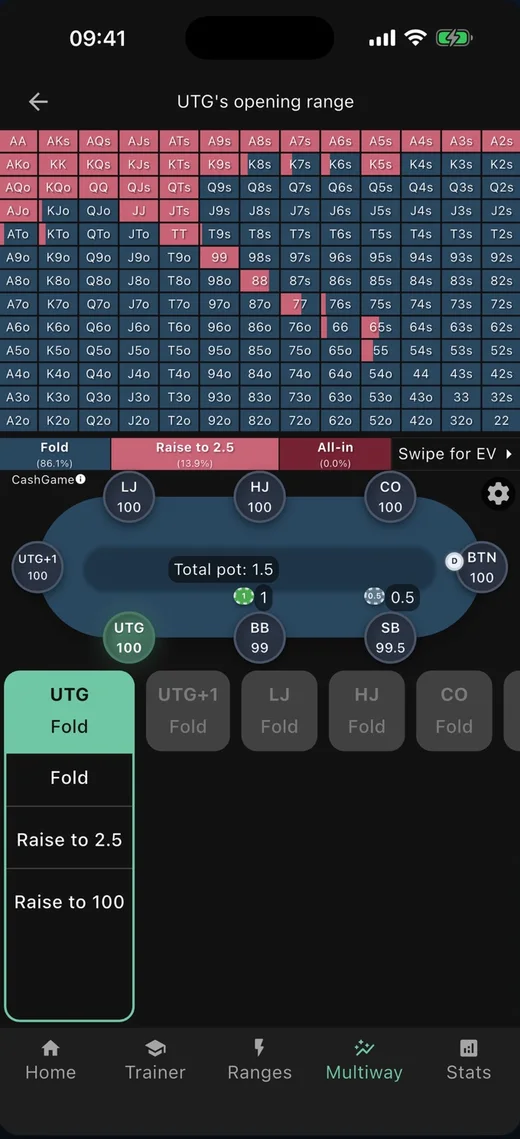
The strip under the table is the part that matters. Each seat gets its own card, and tapping one opens that seat’s options — Fold, Raise to 2.5, Raise to 100 at this configuration. Set the seats in order and the matrix above redraws for the sequence you built, along with the table graphic showing the pot and each stack.
So the hand you actually played — lojack raises, button calls, you’re in the big blind with A5s — becomes a sequence you can enter and look up, rather than a spot you have to reason about from a chart of a different hand.
Tip:
Try it on the last one that annoyed you: open GTO Preflop, go to Multiway, and rebuild the multiway pot you misplayed this week. Reading your hand’s color in that grid takes about fifteen seconds.
Step 3: read the frequencies, then swipe for EV
The header strip gives you the aggregate: how much of the range folds, calls and raises at that node. Swipe it and the matrix switches to EV, so you can see how close the marginal hands are rather than just which side of the line they landed on.
That difference matters more multiway than heads-up. A hand that calls 55% and folds 45% is a coin-flip the solver resolved with a mixed strategy, and knowing it’s close is more useful than memorizing which way it fell. Across the whole database, picking the wrong side of a mix like that costs a median of 0.018 big blinds.
What changes once someone has already called
The mechanics are straightforward, and they all point the same direction.
Fold equity collapses. With three opponents behind your raise, everyone folding is roughly the cube of one player folding. DeepFold puts it at 6.4% when each opponent folds 40% of the time. Hands you’d 3-bet as a pure bluff heads-up lose the mechanism that made them profitable.
Showdown value replaces it. Hands that make the nuts gain: small pairs playing for set value against multiple stacks, suited aces for the nut flush, suited connectors and gappers for straights. Hands that make good-but-not-great top pairs lose: offsuit broadways like AJo and KJo, dominated offsuit aces, and middle pairs that turn into bluff catchers the moment an overcard lands.
Squeeze sizing goes up, because you’re pricing out two players rather than one, and your squeezing range gets more polarized for the same reason. If that’s the part you want to work on, the 3-bet ranges guide covers construction in detail, and position strategy covers why it matters which seat called, not only that somebody did.
None of that is a substitute for looking the spot up. It’s the reasoning that makes the looked-up range make sense.
The limits, stated plainly
Four of them, and I’d rather you heard them here.
The Multiway Range Viewer is a paid feature. The app is free to download; multiway sits behind a subscription, alongside the Simple Range Viewer. The standard plan runs $7.99 a week, $19.99 a month or $119.99 a year. We run price experiments, so the figures on your store listing may differ.
It needs a connection. The 503 two-player solve files live on your device. The multiway tree is fetched from cloud storage as you navigate it, which is exactly why it can be so much larger, and why it won’t help you in a casino basement with no signal.
It’s a viewer, not a trainer. This is the honest gap. The Trainer deals you spots, scores each decision in big blinds and tells you what the mistake cost:
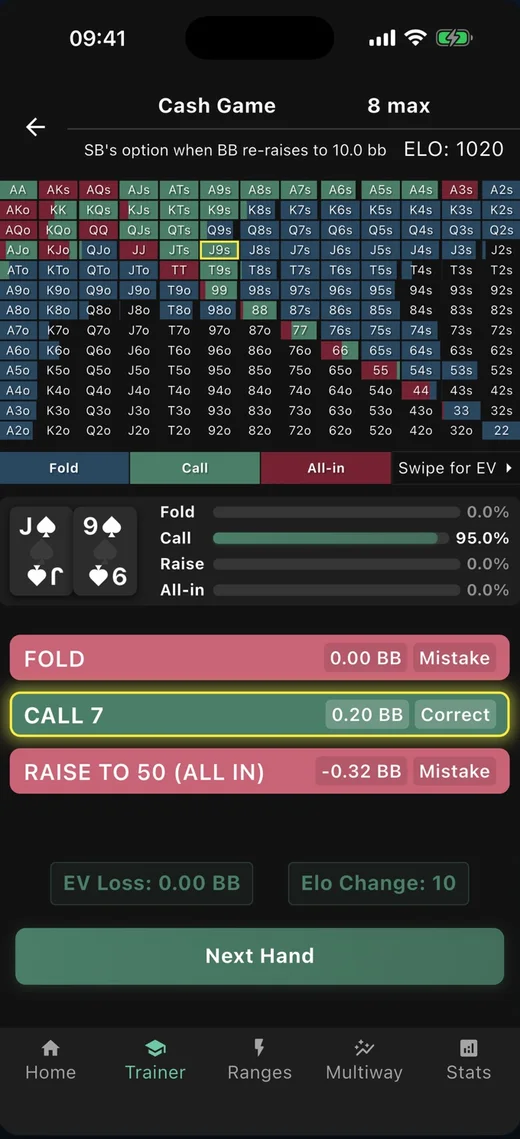
That’s a two-player spot — small blind facing a big blind re-raise to 10bb with J♠9♠, where calling is worth 0.20bb and jamming costs 0.32bb. The trainer runs on the same two-player library the charts do, so you can look a multiway range up, but you can’t drill it. Trainer coverage is cash from 50bb to 200bb and tournaments from 3bb to 12bb; Spin & Go has range coverage but no trainer at all.
The configurations are fixed. You choose from solved stack depths and table sizes rather than typing in arbitrary chip counts. At 7.3 big blinds you read the 8bb solve.
Multiway on a phone versus multiway on a desktop
GTO Wizard launched multiway preflop solving in February 2026 and it’s a genuinely bigger tool than ours: up to nine players, custom stack depths for every seat, custom raise sizes, limping, nodelocking and exploitative player profiles. If you want to solve an arbitrary multiway spot with your own assumptions, that’s the product that does it, and it’s worth saying so.
Two things go with it. Their announcement puts unlimited multiway preflop solving in a new Ultra tier, priced at $229 a month on the annual plan and $279 monthly during an early-bird window, rising to $289 and $359 after. They also give away multiway preflop solving at stack depths up to 10bb, which is a real offer and covers a decent chunk of tournament play.
We’re doing something different at a different price. GTO Preflop is a pre-solved library in your pocket: no solve time, no configuration, no laptop, and the multiway tree sitting in the same app as the charts and the trainer, for a year at less than one month of Ultra. For a player who wants the right answer to a spot they just played, on the device already in their hand, ours is the better shape and the better buy — it’s the app we’d put on your phone. If you want the two compared feature by feature, we wrote GTO Wizard vs GTO Preflop.
Multiway preflop ranges: FAQ
What is a multiway pot in poker?
A multiway pot is one with three or more players in it. Preflop, that means at least two opponents have voluntarily put money in before the flop: an open and a cold call, an open and two callers, or a limped pot with several players.
Why don’t preflop charts cover multiway spots?
Because they’re built as two-player trees. Enumerating every combination of folds, calls and raises across a full table produces vastly more nodes than enumerating “someone raised, you respond”, and the small tree is what fits on a phone and answers instantly. GTO Preflop’s on-device library has 11,385 decision points and none of them has two opponents already in the pot.
How do I look up a multiway preflop range?
In GTO Preflop, open the Multiway tab, pick the game type and table size, then set each seat’s action in order using the strip beneath the table. The hand matrix redraws for that exact sequence, with fold, call and raise frequencies in the header and per-hand EV a swipe away.
Which hands play better in multiway pots?
Hands that make the nuts. Small pairs set-mining against several stacks, suited aces for the nut flush, suited connectors and suited gappers. Offsuit broadways and dominated offsuit aces get worse, because top pair with a weak kicker is a much thinner hand against three ranges than against one.
Should I cold-call more or less than the solver does?
The solve above cold-calls 2.1% to 4.6% from seats with players behind them, which is tighter than almost anyone plays. Against opponents who squeeze rarely and play badly after the flop, calling wider with implied-odds hands is defensible. Against a table that squeezes, take the solver’s word for it.
Is there a free multiway preflop solver?
GTO Wizard gives away multiway preflop solving at stacks up to 10 big blinds. GTO Preflop is free to download, with the Multiway Range Viewer included in the paid plan. There’s no free desktop tool that solves arbitrary multiway preflop spots at full stack depths.
Sources
- Coverage and node counts (503 solve files, 11,385 decision points, 1,924,065 hand strategies) were computed directly from GTO Preflop’s own solve database on August 22, 2026
- Opening and cold-call frequencies are read from the same 8-max 100bb raked cash solve the app ships and displays
- GTO Preflop on the App Store — 4.8 across 240 ratings, version 3.0.30, checked August 22, 2026
- GTO Preflop on Google Play — 4.6 across 3.19K reviews, 100K+ downloads, checked August 22, 2026
- Introducing Multiway Preflop Solving, GTO Wizard — nine-player support, custom stacks, nodelocking, Ultra tier pricing and the free 10bb tier, checked August 22, 2026
- GTO Wizard Launches Multiway Preflop Solver for Up to 9 Players, PokerNews — independent coverage of the February 2026 launch
- Multiway Pot Strategy, DeepFold — fold-equity arithmetic and the hand-category adjustments
- Preflop poker mistakes to avoid, Upswing Poker — loose preflop play as the most common leak among losing players
Product names and brands are the property of their respective owners and are used for identification only. GTO Preflop is not affiliated with or endorsed by GTO Wizard. Prices verified August 22, 2026 — check each vendor’s own page for current figures.