
The short answer
At 100 big blinds in raked cash, the solver 4-bets 18-19% of its opening range when the 3-bet comes from a player in position behind it, and only 9-15% when the 3-bet comes from the blinds. It folds 56-65% of its opens against the first kind and up to 75.7% against the second. And it never 4-bet jams: across every 100bb cash node in GTO Preflop’s solve database, the all-in 4-bet is used exactly 0.0% of the time. The bluff hands aren’t a fixed list, they get rebuilt per node, and in tournaments the whole decision changes shape: below 20bb the 4-bet doesn’t exist, and from 20bb to 40bb every solved 4-bet is all-in. Everything below was measured twice from the 503 solve files that ship inside the app.
Note:
Full disclosure: GTO Preflop is our app, and every number in this article comes from the solve files it ships. The configurations, the weighting method and the validation check are stated in the methodology notes, so all of it is reproducible; the raw data is on your phone if you have the app installed.
The three sizes that build a 4-bet pot
A 4-bet is the second re-raise: someone opens, someone 3-bets, and the opener (usually) raises again. The solved tree at 100bb cash uses one ladder for each of the three ways this fight starts:
| Who 3-bets you | Open | 3-bet | 4-bet | 4-bet multiple |
|---|---|---|---|---|
| A seat behind you (you’re out of position) | 2.5bb | 7.5bb (3x) | 20.25bb | 2.7x the 3-bet |
| The blinds (you’re in position) | 2.5bb | 12bb (4.8x) | 24bb | 2.0x the 3-bet |
| You opened the small blind, the big blind 3-bets | 3bb | 10bb (3.3x) | 27bb | 2.7x the 3-bet |
The pattern to memorize: 4-bet to about 2x the 3-bet when you’re in position, about 2.7x when you’re out of position. GTO Wizard’s deep-stack analysis lands on the same rule, noting that with 100bb stacks in-position 4-bets are “roughly double the 3-bet”. The out-of-position version is bigger because the 4-bettor will play the rest of the hand without position and wants the preflop raise to do more of the work.
What the ladder never includes at 100bb: shoving. The all-in 4-bet is a legal action in every one of these nodes, and its solved frequency is 0.0% in all 28 seat pairs. The same is true one level down, where nobody 3-bet jams at 100bb either. Deep-stacked raise wars stay small on purpose; if you’re regularly 100bb deep and announcing “all-in” before the flop, you’re playing a line the equilibrium doesn’t contain.
The other half of this fight, how the 3-bettor builds the range you’re reacting to, is covered in our 3-bet ranges guide.
How often should you 4-bet?
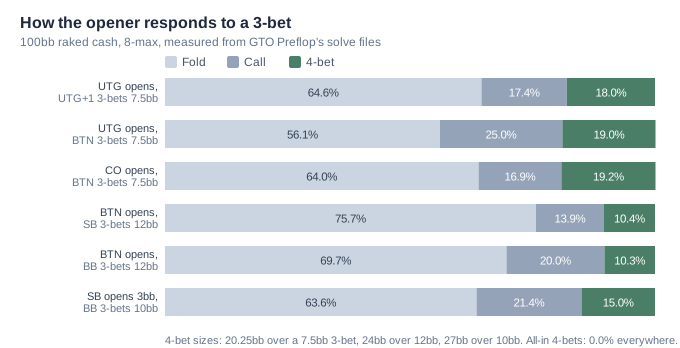
Here’s the opener’s full response, seat pair by seat pair, in 8-max 100bb cash with a 5% rake capped at 4bb:
| You open | The 3-bet comes from | Fold | Call | 4-bet |
|---|---|---|---|---|
| UTG | UTG+1 (7.5bb) | 64.6% | 17.4% | 18.0% |
| UTG | BTN (7.5bb) | 56.1% | 25.0% | 19.0% |
| LJ | BTN (7.5bb) | 57.0% | 24.4% | 18.7% |
| HJ | CO (7.5bb) | 63.6% | 18.3% | 18.1% |
| CO | BTN (7.5bb) | 64.0% | 16.9% | 19.2% |
| UTG | SB (12bb) | 71.4% | 14.1% | 14.5% |
| CO | BB (12bb) | 68.0% | 22.4% | 9.6% |
| BTN | SB (12bb) | 75.7% | 13.9% | 10.4% |
| BTN | BB (12bb) | 69.7% | 20.0% | 10.3% |
| SB | BB (10bb) | 63.6% | 21.4% | 15.0% |
Two structural facts fall out of this table.
The 4-bet frequency barely depends on your seat. It depends on the 3-bettor’s. Against an in-position 3-bet, every opener from UTG to the cutoff 4-bets between 17.6% and 19.4% of its opening range. Move the same 3-bet to the blinds and the 4-bet drops to 9-15%. The blinds 3-bet bigger (12bb against 7.5bb), which makes bluffing more expensive, and their 3-bet arrives with the betting closed behind it, which changes what a call is worth. One number pair covers most of what you need: 18-19% vs position, about 10% vs the blinds.
The widest opener does the most folding. The button folds 75.7% of its opens to a small blind 3-bet, the highest fold rate in the table, and that’s not weakness. A 43.7% opening range is mostly hands that were opened to steal blinds and can’t continue against a 12bb re-raise. UTG’s 13.9% range folds far less often to the same 3-bet. If you open wide and hate folding to 3-bets, you’ve built a strategy out of two halves that don’t fit.
For context on how often this decision comes up: open the cutoff and, in the lines where the players between you fold, the button 3-bets 11.2%, the small blind 8.2% and the big blind 7.7%. Chain those and roughly one cutoff open in four walks into a 3-bet. This is not a corner case you can leave unstudied.
Table size changes almost nothing, by the way. We ran the same measurement at 6-max and every comparable seat pair lands within about a point of its 8-max number (CO vs BTN: 18.3% against 19.2%; BTN vs SB: 10.0% against 10.4%). The small blind’s own war with the big blind is its own animal, with wider ranges on both sides, and gets a full article in our blind vs blind guide.
Which hands 4-bet? The value core and the moving bluffs
The value core is boring, and it should be: AA, KK, QQ and AK 4-bet at high frequency almost everywhere. The interesting part is everything around it. Here’s the button’s full response to a small blind 12bb 3-bet, every hand that 4-bets at least occasionally:
| Hand | Fold | Call | 4-bet |
|---|---|---|---|
| KK | 0% | 0% | 100% |
| AA | 0% | 1% | 99% |
| 0% | 10.5% | 89.5% | |
| AKo | 0% | 20% | 80% |
| A9s | 0% | 22% | 77.5% |
| KTs | 0% | 24% | 75.8% |
| AKs | 0% | 41% | 59.4% |
| A4s | 54% | 3% | 42.8% |
| K9s | 66% | 0% | 33.9% |
| KQo | 67% | 0% | 32.6% |
| JJ | 0% | 76% | 23.6% |
| AJo | 77% | 0% | 23.4% |
| A5s | 6% | 72% | 21.9% |
| TT | 0% | 81% | 19.5% |
| AQs | 0% | 100% | 0% |
| KQs | 0% | 100% | 0% |
Read the bottom two rows first. AQs and KQs never 4-bet here. They’re the textbook “middling” hands: far too strong to fold, not strong enough to want 400 big blinds of preflop action, and they flop well enough that calling keeps all of that value. Every 4-betting guide says to avoid 4-betting the middle of your range; this is what that principle looks like as a number.
Now look at who does the bluffing. The classic advice says suited wheel aces, A5s down to A2s. In this node, A5s 4-bets just 21.9% and mostly calls, while A9s 4-bets 77.5% and KTs 75.8%. The solver’s bluff set isn’t a memorized list, it’s the set of hands sitting just at the edge of a profitable call that still block the 3-bettor’s continues, and where that edge sits depends on the 3-bet’s size. Against the 12bb blind 3-bet, A9s and KTs are the marginal blockers. Against a cheaper 7.5bb in-position 3-bet the calling region widens downward and the wheel aces take over: facing a button 3-bet after a cutoff open, A5s 4-bets 84.8%, A4s 55.9%, and KJs 4-bets 100% of the time.
Notice also the hands that split between folding and 4-betting with almost no calls: A4s, K9s, KQo, AJo. Those can’t call the 12bb 3-bet profitably (their call EVs are negative), but their blockers make them the cheapest hands to attack with. Fold-or-bluff, never flat. That’s polarization as the solver actually plays it.
Your own seat moves the value core too. After opening UTG and facing a button 3-bet, QQ calls 85% of the time and 4-bets just 15%, because against the tight continuing range a UTG open invites, queens no longer want to bloat the pot. TT in the same spot is a genuine three-way indifference: fold 48%, call 43%, 4-bet 10%, all within a hundredth of a big blind of each other. And yes, the solver 4-bets 65s from under the gun occasionally (38% of the times it holds it there), a mix it can afford because the EV gap between its options is nearly zero. Don’t copy that one at the table; frequencies are decoration, range boundaries are money.
Tip: every node in this article is browsable in GTO Preflop. Open the 100bb cash tree, put yourself on the button against a small blind 3-bet, and tap any hand: the app shows the frequency and the EV of every action, including the sizings this article didn’t have room for.
What slow-playing costs: the EV of the 4-bet
The solve files store the EV of every action for every hand, which means we can price the popular mistakes instead of arguing about them.
Flatting AA against an in-position 3-bet is the expensive trap. After a cutoff open and a button 3-bet, AA earns 26.57bb by 4-betting and 22.12bb by calling: slow-playing costs 4.4 big blinds every time you do it. KK gives up 2.5bb the same way. Against a small blind’s bigger 3-bet the same slow-play is nearly free (AA: 32.47bb for the 4-bet, 32.31bb for the call), because the call already builds a 24bb pot and the stacks go in behind it soon enough anyway. So the “never slow-play aces” rule is really an in-position-3-bettor rule, and it’s worth about as much as winning an entire average pot.
The reverse mistake has a price tag too. 4-betting AQs on the button against a small blind 3-bet, instead of calling, burns 1.38bb per occurrence. KQs burns 0.93bb. Turning your best calling hands into bluffs is the same class of error as flatting aces, and the solver quantifies both.
What about never 4-betting at all? We removed the 4-bet from the opener’s strategy, replaced every 4-bet with that hand’s best remaining action, and let the 3-bettor keep playing equilibrium. Against a button 3-bettor the cutoff loses 0.115bb per 3-bet faced. Against a small blind 3-bettor the loss is only 0.008bb, since at the 2x price calls substitute almost perfectly. Two things follow. First, the 4-bet earns its money against in-position 3-bettors, exactly where the 18-19% frequency lives. Second, these are floors: the moment observant opponents notice you never 4-bet, they 3-bet you more and the real cost climbs.
Tournaments: the 4-bet disappears below 20 big blinds
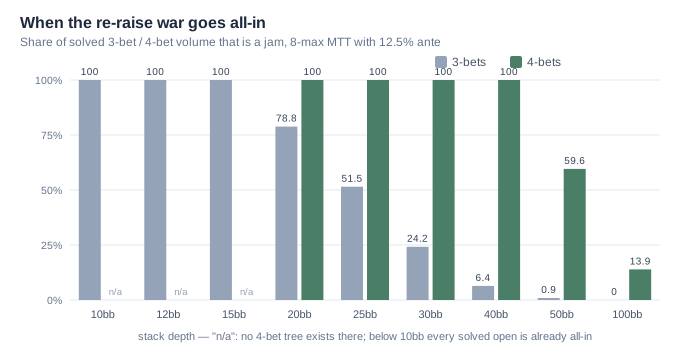
Everything above assumes 100bb. Tournament stacks break the 4-bet in stages, and the stages are sharp. We swept the 8-max ChipEV solves with a 12.5% ante at every shipped depth and measured what share of each re-raise type is all-in:
| Depth | What a 3-bet looks like | What a 4-bet looks like |
|---|---|---|
| 3-8bb | There is no 3-bet: every solved open is already all-in | Doesn’t exist |
| 10-15bb | 100% all-in | Doesn’t exist: the “4-bet decision” is calling a jam |
| 20-40bb | Small 3-bets appear (6bb at 20bb, up to 9.2bb at 40bb) | 100% all-in |
| 50bb | 0.9% of 3-bets are all-in | First non-all-in 4-bet appears, at 0.1% frequency; 59.6% of 4-bet volume is still the jam |
| 100bb | 0% | 13.9% of 4-bet volume is all-in (raked cash at the same depth: 0%) |
In practice: the small, playable 4-bet you know from cash games is a 50bb-and-deeper luxury. At 25bb, when the big blind makes a small 3-bet over your button open, your entire non-fold, non-call menu is shoving, and the solver uses it: at 20bb the button folds 44.3%, calls 33.8% and jams 21.8% against the big blind’s 6bb 3-bet. At 10bb the ladder has collapsed one level further down. The big blind’s “3-bet” is a re-jam (it does this with 22.2% of hands against a button min-raise), and the button’s decision is reduced to calling off 54.8% or folding.
Even at a full 100bb, tournament 4-betting keeps a jam component cash games don’t have: one MTT 4-bet in seven is all-in, against zero in raked cash. Antes make the pot bigger relative to the stacks, opens are smaller, and there’s no rake discouraging the action. If you play tournaments, stack depth rewrites the whole preflop tree, and the 4-bet is where the rewrite is most visible.
50bb cash: calling mostly leaves the menu
Halve the cash stacks and the response to a 3-bet polarizes hard. On the button facing a small blind 3-bet at 50bb, the solver folds 82.0%, calls 2.1%, and 4-bets 15.9%. In the cutoff against a button 3-bet: fold 71.8%, call 5.2%, 4-bet 23.0%. Compare the 100bb rows above: the calls (13.9% and 16.9%) have almost vanished, and the 4-bets are half again bigger.
The reason is playability. Calling a 3-bet at 50bb means playing a bloated pot with no room to maneuver and no implied odds for your suited connectors and small pairs. So the solver stops flatting and splits into fold-or-raise. If your 50bb strategy is “same as 100bb but a bit tighter”, this node is where that costs you. And it still doesn’t shove: even at 50bb, the all-in 4-bet stays at 0.0% in cash.
Cold 4-betting
A cold 4-bet is a 4-bet from a player with no chips in the pot yet: someone opens, someone else 3-bets, and a third player re-raises over both. Our library solves one opener against one 3-bettor and carries no three-player nodes at all (we measured that fact for the multiway ranges article), so we can’t put solved frequencies on cold 4-betting, and we won’t invent any. The structure of the spot tells you the direction: you’re facing two ranges that have both claimed strength, so a cold 4-bet range has to sit far above an opener’s 4-bet range, concentrated in the very top of the value core. If your cold 4-bets are wider than your in-the-pot 4-bets, something has gone badly wrong.
Common 4-bet mistakes
One 4-bet size everywhere. The tree uses 2x in position against the blinds and 2.7x out of position, and the difference matters at both stack depths. A single memorized “2.5x” is wrong in every node, in opposite directions.
4-betting the middle of your range. AQs and KQs are pure calls against a blind 3-bet, at a measured cost of 1.38bb and 0.93bb when you 4-bet them anyway. The hands between value and bluff want to see a flop.
One universal bluff list. A5s is a great 4-bet bluff against a 7.5bb in-position 3-bet (84.8% frequency) and mostly a call against a 12bb blind 3-bet (21.9%), where A9s and KTs do the job instead. Copy the node, not the meme.
Slow-playing aces against in-position 3-bettors. 4.4bb per flat. The same play against a blind 3-bet is roughly free, which is why the habit survives: it only punishes you in half the nodes.
Importing cash 4-bets into a 25bb tournament. There is no small 4-bet there. The solved options are fold, call, and all-in, and pretending otherwise usually means min-4-betting yourself into a pot you can’t leave.
4-bet jamming 100bb deep. Frequency in the solve files: 0.0%, in every cash seat pair. If your deep-stack plan against a 3-bet is “shove and let the math sort it out”, the math has sorted it: it folds out everything you beat and gets called by everything that beats you.
Drilling it
Knowing that the button 4-bets 10.4% against a small blind 3-bet doesn’t mean your hands know which 10.4%. GTO Preflop’s trainer deals you cash hands from 50 to 200 big blinds, where every 4-bet node in this article lives, and tournament spots from 3 to 12 big blinds, which is exactly the jam-or-call regime from the depth table. Each decision is graded against the solved answer with the EV difference attached, so flatting aces in the wrong node shows up as a number, not a feeling. The range viewer covers all 503 files at every depth. The app is free to download on iOS and Android.
If you want the full market picture first, the best preflop chart apps roundup compares it honestly against six alternatives.
FAQ
How often should you 4-bet?
At 100bb in raked cash: 18-19% of your opening range when the 3-bet comes from a player in position behind you, and roughly 9-15% when it comes from the blinds. Those figures hold at every opening seat; what moves them is who 3-bet you, not where you opened.
What hands should you 4-bet?
The value core is AA, KK, QQ and AK, with QQ dropping to a 15% 4-bet after a UTG open. Around the core, 4-bet hands that block the 3-bettor’s continues but can’t profitably call: which hands those are depends on the node. Never 4-bet the strong middle (AQs, KQs); it calls.
How big should a 4-bet be?
About 2x the 3-bet when you’re in position (24bb over a 12bb blind 3-bet), about 2.7x when you’re out of position (20.25bb over a 7.5bb 3-bet, 27bb over 10bb in the blind battle). Smaller in position, bigger out of position.
When should you 4-bet all-in?
In tournaments between 20bb and 40bb, always: every solved 4-bet at those depths is a jam. At 100bb cash, never: the all-in 4-bet has 0.0% frequency in every node. Deep-stacked shoving wars only exist below equilibrium.
What is the best 4-bet bluff?
There’s no universal answer. Against in-position 3-bets the suited wheel aces lead (A5s 4-bets 84.8% after a CO open vs a BTN 3-bet, and KJs 4-bets 100%). Against the blinds’ bigger 3-bets the marginal blockers take over: A9s at 77.5% and KTs at 75.8% on the button against a small blind 3-bet.
Do 4-bet ranges change in tournaments?
Completely. Below 20bb the 4-bet doesn’t exist (every 3-bet is already all-in). From 20 to 40bb the only 4-bet is a shove. The small, cash-style 4-bet appears at 50bb and even at 100bb one tournament 4-bet in seven is all-in, driven by antes and smaller opens.
Sources
- GTO Preflop’s on-device solve library — 503 Brotli-compressed solution files, 11,385 decision points, 1,924,065 hand strategies; every 4-bet node read directly and combo-weighted on August 29, 2026, in two independent implementations that agreed exactly
- Method validation — first-in opening frequencies reproduced from the same traversal (8-max, 100bb, 5% rake / 4bb cap: 13.9% UTG, 43.7% button) and matched against the figures printed on GTO Preflop’s App Store screenshots
- GTO Preflop on the App Store — version 3.0.30, free download, 4.8/5 from 240 ratings, checked August 29, 2026
- GTO Preflop on Google Play — 4.6/5 from 3.23K reviews, 100K+ downloads, checked August 29, 2026
- GTO Wizard: IP 4-Betting in Deep-Stacked Cash Games — source for the independent sizing observation that in-position 4-bets run roughly double the 3-bet at 100bb, accessed August 29, 2026
- PokerCoaching: Mastering the 4-Bet — the qualitative value/bluff/position framing this article puts numbers on, accessed August 29, 2026
Every figure on this page was computed from GTO Preflop’s shipped solve files on August 29, 2026 and is reproducible from the app. Cash figures use the 8-max (and, where stated, 6-max) 100bb and 50bb solves with 5% rake capped at 4bb and a 2.5bb open (3bb from the small blind); tournament figures use the 8-max ChipEV solves with a 12.5% ante. Hand frequencies are combo-weighted (6 per pair, 4 suited, 12 offsuit); EVs are in big blinds with folding fixed at zero. The library caps its trees at the opener’s response to the 3-bet, so the 3-bettor’s play against a non-all-in 4-bet is outside its scope and is not quoted here.