
The short answer
Blind vs blind is the spot where correct preflop play swings hardest between formats. In 100bb raked cash, the solver plays 45.7% of small blinds first-in: it raises to 3bb or folds, and completes just 2.3%. In an ante tournament at the same 100bb, it plays 91.6% of hands, and 86.0% of that is a limp. Between those poles sits a jam-heavy short-stack game: at 8 big blinds, the small blind moves all-in with 60.8% of everything it’s dealt. We measured every blind-vs-blind node in GTO Preflop’s solve database, both seats, 14 tournament depths plus cash, and this article is the map.
Note:
Full disclosure: GTO Preflop is our app, and every number below comes from the solve files it ships. The configurations, the weighting method and the validation check are stated in the methodology block, so all of it is reproducible; the raw data is on your phone if you have the app installed.
Why blind vs blind is its own game
When the table folds around to the blinds, three things flip at once.
The big blind has position. In every other single-raised pot, the preflop caller in the big blind plays the whole hand out of position. Blind vs blind is the lone exception: the small blind acts first on every street, forever. Whoever wins the preflop battle still has to play the war from the worst seat.
The small blind already paid half. Completing costs 0.5bb into a pot that, in an ante tournament, already holds around 2.5bb. That’s the cheapest flop poker ever offers, which is why limping, extinct everywhere else in solver play, comes back to life here.
And there’s nobody left to squeeze. Six or seven players have folded. The ranges that fight for this pot are the two widest ranges at the table, which is why blind battles produce more strange-looking hands, thinner value bets and lighter bluff-catches than any other matchup.
The result: the small blind’s solved strategy uses every tool in the box, at frequencies that would be blunders from any other seat. Here’s what it actually does.
Small blind strategy in cash games: raise big or get out
At 8-max 100bb with a 5% rake capped at 4bb, the small blind facing seven folds plays like this: fold 54.3%, raise to 3bb 43.4%, complete 2.3%. The open-jam exists in the tree and gets used exactly never.
Two details in that line are worth more than the headline numbers.
The size is 3bb. Every other seat in the same database opens 2.5bb; the small blind is the one position the solver sizes up. The logic is positional: a bigger raise charges the one player who can call you in position, and it denies the big blind the near-perfect price a min-raise would offer. If you open 2.5bb from the small blind because that’s your standard, you’re giving the big blind a discount the solver refuses to give.
The limp is nearly extinct. No single hand completes more than 30% of the time (Q9s tops the list at 30%), and the whole completing range adds up to 2.3% of hands. Aces raise 99%. There is no trapping range, because a raked, ante-free pot doesn’t pay enough to play a capped range out of position. The boundary of the opening range is razor thin: J3s opens almost pure and earns +0.001bb doing it, the literal zero line.
The big blind’s answer is the widest defense in the game. Against the 3bb open it folds only half its hands, defending 50.0%, more than against any other seat’s open, with a 33.8% call and a 16.2% 3-bet to 10bb. The full seat-by-seat defense table lives in our big blind defense article; what matters here is the 3-bet range’s shape. A2o and A3o 3-bet essentially always, J2s goes 99% and K7o 97%, while K5s and K2s never 3-bet and just call. Against a button open, A2o is a pure fold; against the small blind, the same hand becomes a pure 3-bet. Blocker value and a foe who must play out of position change everything.
And the small blind’s response to that 3-bet vindicates the big blind’s aggression: it folds 63.6% of its opens, calls 21.4% and 4-bets to 27bb with 15.0%. Nearly two-thirds of small blind opens surrender the pot the moment the big blind raises. That single number is why a passive big blind in blind battles is burning money.
Methodology, briefly. Every figure comes from GTO Preflop’s shipped solve files, read directly and combo-weighted (6 combos per pair, 4 suited, 12 offsuit). Cash figures use the 8-max, 100bb, 5% rake / 4bb cap solves; tournament figures use the 8-max ChipEV solves with a 12.5% ante. Before computing anything, we reproduced the library’s published first-in frequencies, 13.9% UTG and 43.7% button at 100bb raked cash, which match the figures printed on the app’s own App Store screenshots. We also ran every blind-vs-blind measurement twice, in two independent implementations, and only report where they agree. Conditional frequencies are only quoted at nodes the strategy actually reaches.
Small blind strategy in tournaments: the limping game
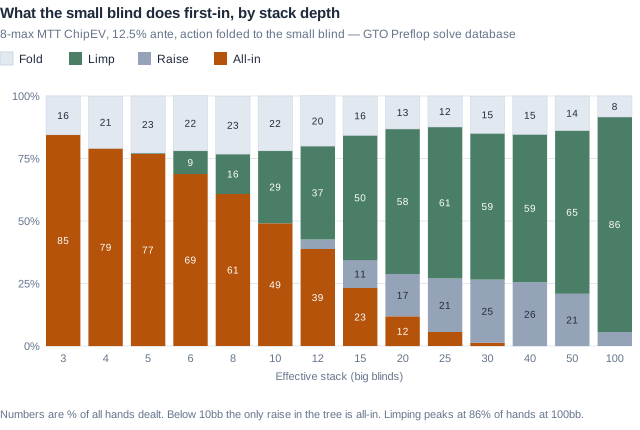
Add a 12.5% ante and remove the rake, and the small blind turns into a different player. Here’s the full first-in picture across every solved depth:
| Depth | Fold | Limp | Raise | All-in |
|---|---|---|---|---|
| 3bb | 15.5% | 0% | — | 84.5% |
| 4bb | 20.8% | 0% | — | 79.1% |
| 5bb | 22.8% | 0.3% | — | 76.9% |
| 6bb | 22.0% | 9.3% | — | 68.8% |
| 8bb | 23.1% | 16.0% | — | 60.8% |
| 10bb | 21.9% | 29.0% | 0% | 49.1% |
| 12bb | 20.1% | 37.4% | 3.8% (2.5bb) | 38.8% |
| 15bb | 15.7% | 49.9% | 11.2% (2.5bb) | 23.2% |
| 20bb | 13.2% | 58.0% | 16.9% (3bb) | 11.9% |
| 25bb | 12.4% | 60.6% | 21.4% (3bb) | 5.6% |
| 30bb | 14.8% | 58.5% | 25.3% (3.5bb) | 1.3% |
| 40bb | 15.3% | 59.2% | 25.5% (3.5bb) | 0% |
| 50bb | 13.8% | 65.3% | 20.9% (3.5bb) | 0% |
| 100bb | 8.4% | 86.0% | 5.6% (4bb) | 0% |
Read it as three regimes.
3 to 8 big blinds: jam or fold. The only raise in the tree is all-in, and the solver uses it with 60% to 85% of hands. Limping barely exists until 6bb. If you’re folding a third of your small blinds at these depths, you’re giving up the most profitable shove in poker; the push/fold tools roundup covers this territory in depth.
10 to 15 big blinds: the mixed zone. The jam share falls from 49.1% to 23.2% while limping climbs from 29.0% to 49.9%. At 15bb the small blind limps half of everything it’s dealt, and a small 2.5bb raise finally enters the strategy at 11.2%.
20 big blinds and up: the limping game. Limping is now the main action at every depth, climbing from 58.0% to 86.0% at 100bb, and the open-jam disappears entirely above 30bb. Fold rates collapse too: at 100bb the tournament small blind folds 8.4% of hands. Only the very worst holdings, 32o through 92o and their neighbors, still hit the muck.
The raise sizes tell their own story. When the tournament solver does raise, it picks 2.5bb at 12-15bb, 3bb at 20-25, 3.5bb at 30-50 and 4bb at 100, always well above the 2.0-2.3bb the other seats use at the same depths. Same pattern as cash: out of position against the pot-closing seat, size up. Depth changes the whole preflop tree, not just this seat, and our MTT stack size guide maps the rest of it.
These aren’t quirks of our solver. BBZ Poker’s apestyles guide publishes solver frequencies for the same tournament spot at five depths, and they land within a couple of points of ours everywhere the two overlap: their 10bb line is limp 29.4% / all-in 49.6% / fold 21.1% against our 29.0 / 49.1 / 21.9. Two independently built solutions agreeing that closely is about as much confirmation as preflop strategy gets.
Note: every tournament number on this page is ChipEV: chips, no payout pressure. Under ICM, on bubbles and final tables, the shift goes further in the direction this article already points. GTO Wizard’s analysis of the small blind under ICM finds the raising range narrowing toward a nearly pure limp-or-fold strategy as risk premiums climb. If you internalize the limping game at ChipEV, you’re moving toward correct ICM play, not away from it.
What’s inside the limping range
Here’s the 15bb limping range, and why nobody can read a limp: everything. K2s, T2s, 32s and J2o limp 100% of the time. A5s limps 100%. AKs limps 85%, AKo 77%, and AA limps 65% of the time. Meanwhile QQ always raises small, and 76s open-jams 15 big blinds, pure. The limp isn’t a weakness signal; it’s the whole range compressed into one action, monsters included.
The plan behind each limp only shows up when the big blind raises. Facing a 3bb raise over its limp at 15bb, the small blind folds 34.9%, calls 50.7% and re-jams 14.4%. And the composition of that re-jam is the beautiful part: AA and KK limp-call, 100%, keeping every bluff in the big blind’s range alive. The limp-jams are AKo and A5s, hands that block calls and still flip when called. If you’ve ever limp-jammed aces and watched everything fold, the solver felt that pain first and fixed it.
At 100bb ante play the same logic holds with even more limping: AA completes 99% of the time. AKs is the interesting exception, raising 94%, one of the few hands that wants the pot big and the range uncapped right away.
Same seat, same stack, opposite strategy
Put the two 100bb strategies side by side and blind vs blind becomes the sharpest format contrast in the entire preflop library:
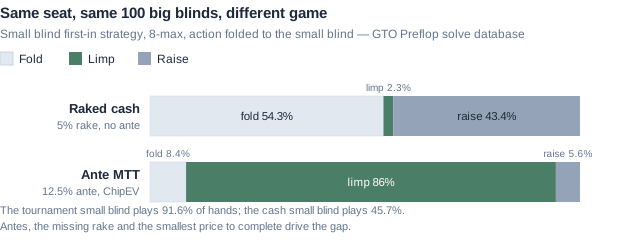
The cash small blind plays 45.7% of hands; the tournament small blind plays 91.6%. Three honest drivers, all pulling the same way. The antes add roughly a full extra big blind of dead money to an 8-max pot, so every completed 0.5bb buys a bigger prize. The ChipEV solves carry no rake, while the cash pot pays 5% the moment a flop arrives, a tax that hits limped pots hardest relative to their size. And with the pot fatter, folding the discounted half-blind becomes the expensive option rather than the safe one.
The value of playing the seat correctly moves just as far. Weighted across every hand dealt, the small blind’s full first-in strategy earns +0.19bb per hand over folding everything in 100bb raked cash, and +0.67bb per hand in the 100bb ante tournament, three and a half times as much. If you bring your cash discipline to a tournament small blind and fold 54% of hands, roughly half a big blind per blind battle never reaches your stack. Blinds come around every orbit. That leak compounds faster than almost anything else in your game.
Tip: every node in this article is browsable in GTO Preflop. Open any tree, put yourself in the small blind first-in, and tap a hand: the app prints the frequency and the EV of every legal action at that depth, including all the mixes this article rounds off.
How the big blind fights back
The small blind’s wide, capped-looking lines only work if the big blind lets them. The solver’s big blind doesn’t.
Against the limp: attack. At 15bb, facing a small blind limp, the big blind checks only 55.9%: it raises to 3bb 30.0% of the time and jams 14.1%. That’s 44% aggression against an action most players read as “free flop, why not.” At 100bb ante play it raises 41.6% of limps, and in cash it raises 40.4%, a figure our big blind defense article flags as one of the most-missed plays in the position. A limp is cheap for the small blind, and charging it is exactly how the big blind gets paid for position.
Against the raise: defend wide, jam the middle. Facing the small blind’s 2.5bb open at 15bb, the big blind folds just 23.8%: it calls 57.5% and re-jams 18.7%. Even at 100bb, against the solver’s 4bb open, it still defends 63.7% (51.6% call, 12.1% 3-bet to 12bb). Compare that to the 50.0% defense against a 3bb open in raked cash and the format gap shows up on this side of the battle too.
Against the jam: call by the chart, not by feel. When the small blind’s only raise is all-in, big blind play reduces to one clean ladder:
| Depth | BB calls a small blind jam |
|---|---|
| 3bb | 96.4% |
| 4bb | 80.0% |
| 5bb | 69.0% |
| 6bb | 61.7% |
| 8bb | 51.1% |
| 10bb | 43.7% |
| 12bb | 37.3% |
| 15bb | 30.4% |
At 3 big blinds you call with nearly everything you’re dealt; at 15, with the top 30%. Notice how wide every one of these is compared to intuition: at 8bb, half of all hands call off a shove, because the jammer’s range is 60% of hands and your pot odds are enormous. Folding “to wait for a better spot” at these depths is the mistake the chart exists to kill.
One more number for the small blind’s benefit: after opening 2.5bb at 15bb and facing the big blind’s re-jam, the solver calls it off 42.1% of the time. Opens at this depth aren’t polite probes; they arrive pre-committed surprisingly often.
Common blind vs blind mistakes
Completing the small blind in cash because it’s cheap. The raked-cash solver completes 2.3% of hands. If your default is “half price, see a flop,” you’re playing a strategy the solver allocates to one hand in forty, in the highest-rake pot type poker offers.
Folding the tournament small blind like a cash player. The ante solver never folds more than 23.1% of small blinds at any depth, and folds 8.4% at 100bb. Every fold above that line hands the big blind dead money plus the antes, an orbit tax you pay voluntarily.
Opening 2.5bb from the small blind because it’s your standard. The solver sizes every small blind open above the table standard: 3bb in cash against everyone else’s 2.5bb, and 2.5-4bb in tournaments against everyone else’s 2.0-2.3bb. Min-raising here prices the big blind into perfect defense.
Reading limps as weakness at 15-20bb. The 15bb limping range holds 65% of aces, 85% of AKs and 100% of A5s alongside all the junk. Raise-attacking every limp “because limpers are weak” runs straight into the 14.4% limp-jam and the AA limp-call.
Auto-checking the big blind against a limp. The solver attacks a small blind limp 40-44% of the time across every format we measured. Checking your whole range surrenders the one edge the big blind always has in a blind battle: position with the betting lead available.
Ignoring the format your chart was solved for. The same seat at the same depth plays 45.7% in raked cash and 91.6% with antes. A blind-vs-blind chart that doesn’t state its rake and ante structure isn’t a chart; it’s a guess. Our range memorization study found the same thing across the whole database: the money is in knowing which ranges apply where, not in memorizing mixed frequencies.
Drilling blind vs blind spots
Reading this page and playing these spots at speed are different skills. GTO Preflop’s trainer deals tournament hands at 3 to 12 big blinds, exactly the jam-or-fold and early mixed zone where blind-vs-blind mistakes cost the most, and cash hands from 50 to 200bb, then grades every decision against the solved answer and tracks your EV loss per 100 hands. The 15bb-and-deeper tournament limping game is fully browsable in the range viewer at every depth in the table above. The app is free to download on iOS and Android, with the standard plan at $7.99/week, $19.99/month or $119.99/year (we run pricing experiments, so exact prices can vary).
If you want to compare tools first, the best preflop chart apps roundup covers the field honestly.
FAQ
Should you limp from the small blind?
Depends entirely on the format. In raked cash games the solver completes just 2.3% of hands: raise 3bb or fold. In ante tournaments limping is the main action from 10bb up, reaching 49.9% of hands at 15bb and 86.0% at 100bb. Neither strategy is right in the other game.
What percentage of hands should the small blind play blind vs blind?
In 100bb raked cash, 45.7% (43.4% raise, 2.3% complete). In ante tournaments, between 76.9% and 91.6% depending on depth, and it never drops below 76% at any solved depth. The tournament small blind folds far less than most players believe.
Why do solvers limp aces from the small blind?
Because the limping range needs protection. At 15bb, AA limps 65% and then calls a raise 100% of the time, which means every big blind raise over a limp risks running into a monster. Remove the strong hands from the limps and the big blind could attack every limp profitably. The bluffing side of the re-jam goes to hands like AKo and A5s, which block calls; the same blocker logic drives 3-bet range construction everywhere else.
How do you play against a small blind limp?
Aggressively. The solver’s big blind raises a 15bb limp 30.0% of the time and jams over it another 14.1%, and still raises about 40% of limps at 100bb in both cash and tournaments. Checking is fine with your weakest hands, but auto-checking gives up the position advantage that makes the big blind the favorite in blind battles.
What size should the small blind raise?
Bigger than the table standard. The solver opens 3bb from the small blind in cash where every other seat opens 2.5bb, and 2.5-4bb in tournaments where other seats open 2.0-2.3bb. Out of position against the one player who closes the action, a larger raise denies the big blind a profitable price.
Is blind vs blind different in cash games and tournaments?
More different than any other preflop spot we’ve measured. The same 100bb small blind plays 45.7% of hands in raked cash and 91.6% in an ante tournament, and the main action flips from a 3bb raise to a limp. Antes, rake and open sizes drive the gap, so know which game your numbers came from before trusting them.
Sources
- GTO Preflop’s on-device solve library — 503 Brotli-compressed solution files, 11,385 decision points, 1,924,065 hand strategies; every blind-vs-blind node read directly and combo-weighted on August 28, 2026
- Method validation — first-in opening frequencies reproduced from the same traversal (8-max, 100bb, 5% rake / 4bb cap: 13.9% UTG, 43.7% button), matching the figures printed on GTO Preflop’s App Store screenshots; all blind-vs-blind figures computed twice in independent implementations
- GTO Preflop on the App Store — version 3.0.30, free download, 4.8/5 from 240 ratings, checked August 28, 2026
- GTO Preflop on Google Play — 4.6/5 from 3.22K reviews, 100K+ downloads, checked August 28, 2026
- BBZ Poker: The apestyles Guide to Small Blind vs Big Blind — independent solver frequencies for tournament small blind play at 10-60bb, used as a cross-check; accessed August 28, 2026
- GTO Wizard: ICM and Blind Battles — The Small Blind — Andrew Brokos on how ICM pressure pushes the small blind toward limp-or-fold; accessed August 28, 2026
- PokerCoaching: How To Play Blind vs. Blind — the conceptual limp/call, limp/raise, limp/fold framework this article puts numbers on; accessed August 28, 2026
Every figure on this page was computed from GTO Preflop’s shipped solve files on August 28, 2026 and is reproducible from the app. Cash figures use the 8-max, 100bb, 5% rake / 4bb cap solves (3bb small blind open, 2.5bb elsewhere); tournament figures use the 8-max ChipEV solves with a 12.5% ante and no rake. Frequencies are combo-weighted percentages of all hands dealt; EVs are in big blinds with folding fixed at zero. Conditional lines are quoted only at nodes the equilibrium strategy actually reaches. 6-max blind-vs-blind numbers land within one point of the 8-max figures at every shared node.