The short answer
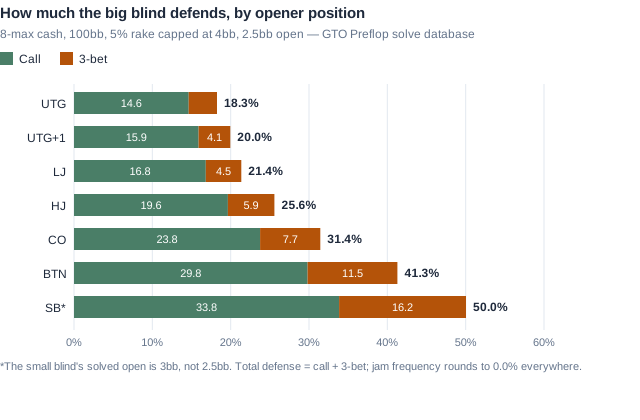
Big blind defense scales with the opener’s position, and the spread is bigger than most players think. In 100bb cash with a 5% rake, the solver defends 18.3% of hands against a UTG 2.5bb open, 31.4% against the cutoff, 41.3% against the button, and 50.0% against a small blind 3bb open. In tournaments with antes, the same button open gets defended 58% to 87% of the time depending on stack depth. Those aren’t opinions. We pulled them from the 503 solve files that ship inside GTO Preflop, and we also priced the leak this article exists to fix: defending nothing but premium hands against a button open gives up 9.6 big blinds per 100 opens you face.
Note:
Full disclosure: GTO Preflop is our app, and every number below comes from the solve files it ships. The configurations, the weighting method and the validation check are stated in the methodology block, so all of it is reproducible; the raw data is on your phone if you have the app installed.
Why the big blind plays wider than any other seat
Three things are true in the big blind and nowhere else at the table.
You’ve already paid. Facing a 2.5bb open, you’re calling 1.5bb, not 2.5bb, because your posted blind counts. Every other caller pays full price.
Your call ends the preflop betting. When the action folds to you against a single raiser, there’s nobody left behind you to re-raise. Callers in other seats always face that risk.
And the price is short. With a 2.5bb open and the small blind’s dead 0.5bb in the middle, you’re calling 1.5bb into a 4bb pot: you need about 27% raw equity before rake. Almost any two cards have that against a wide opening range, which is why pot odds alone would tell you to defend nearly everything.
So why doesn’t the solver? Because you’ll play the whole hand from the worst seat at the table. The big blind acts first on every postflop street against every opener except the small blind, and hands realize meaningfully less than their raw equity from there. The solved defense ranges below are the balance point between the best preflop price in poker and the worst postflop position.
How wide should you defend the big blind?
Here’s the full picture from the solve database, 8-max cash, 100bb, 5% rake capped at 4bb:
| Opener | Open size | Call | 3-bet | Total defense | EV of defending |
|---|---|---|---|---|---|
| UTG | 2.5bb | 14.6% | 3.6% | 18.3% | 0.11 bb/hand |
| UTG+1 | 2.5bb | 15.9% | 4.1% | 20.0% | 0.12 bb/hand |
| LJ | 2.5bb | 16.8% | 4.5% | 21.4% | 0.14 bb/hand |
| HJ | 2.5bb | 19.6% | 5.9% | 25.6% | 0.16 bb/hand |
| CO | 2.5bb | 23.8% | 7.7% | 31.4% | 0.21 bb/hand |
| BTN | 2.5bb | 29.8% | 11.5% | 41.3% | 0.30 bb/hand |
| SB | 3.0bb | 33.8% | 16.2% | 50.0% | 0.43 bb/hand |
The EV column is the value of the whole defending strategy against folding every hand, per hand you’re dealt in that spot. Correct defense against a button open earns you 0.30bb every single time it happens. That’s 30bb per 100 button opens, recovered by one decision.
Two things in this table are worth committing to memory. The defense range vs the button (41.3%, which is 548 of 1,326 combos) is more than double the range vs UTG (18.3%). Play them the same and you’re losing in both directions. And table size barely matters: we ran the same measurement at 6-max, and every shared position lands within one point of its 8-max number. Defense tracks the opener’s seat, not the number of players the table started with.
Methodology, briefly. Each figure comes from the node where the big blind faces a single open after everyone else folds, in GTO Preflop’s shipped solve files. Hand frequencies are combo-weighted (6 per pair, 4 suited, 12 offsuit). Before computing anything we reproduced the library’s published first-in frequencies (13.9% UTG, 43.7% button at 8-max 100bb raked cash), which match the figures printed on the app’s own App Store screenshots.
Call or 3-bet? How the defense splits
Calling does most of the work: at every position, roughly three-quarters of the defense is flatting. But the 3-bet share grows fast as the opener gets later, from 3.6% vs UTG to 11.5% vs the button and 16.2% vs the small blind, and the solved 3-bet size is big: 12bb over a 2.5bb open, out of position.
What the solver 3-bets against a button open is a lesson in range construction on its own:
- Always: AA, KK, QQ, JJ, AKs, AKo, AQs. No surprises at the top.
- Mostly: T9s at 96% and JTs at 93%. Suited connectors that flop well in a bloated pot 3-bet more often than TT (67%) does.
- The blocker hands: A5o 3-bets 87% of the time, A5s 69%, K2s 43%, K3s 31%. An ace or king in your hand makes the opener’s continues less likely.
- Almost never as a bluff: the middling suited aces. A4s, A3s and A2s call essentially always, while A5s 3-bets. The gap between them is tiny (0.672bb for the A5s 3-bet against 0.657bb for its call), but the solver takes the straight-making wheel ace with the best kicker and flats the rest.
One pattern deserves its own sentence: no suited king ever folds to a button open. K2s through K9s defend 100% of the time, mostly as calls, while A2o is a pure fold in the same spot. Suitedness plus a card that blocks the opener’s best hands beats a bare ace-high kicker.
If your 3-bets from the big blind are only value, the 3-bet ranges guide covers how the bluff side gets built. The short version: the solver picks bluffs for blockers and playability, not for prettiness.
Tip: every node in this article is browsable in GTO Preflop. Open the 100bb cash tree, put yourself in the big blind against a button open, and tap any hand: the app prints the frequency and the EV of each action, including the ones this article didn’t have room for.
Does minimum defense frequency apply preflop?
MDF is the number everyone quotes here, so let’s test it against the data. The formula is MDF = pot / (bet + pot). A button open risks 2.5bb to pick up 1.5bb of blinds, so MDF = 1.5 / (2.5 + 1.5) = 37.5%. Flip it around and the classic bound says the blinds together may fold at most 62.5% of the time, or the button prints money opening any two cards.
Now the measured reality. The big blind folds 58.7% against that open. The small blind folds 83.7% (it defends just 16.3%, and mostly by 3-betting: 11.5% raises against 4.7% calls). Both blinds fold about 49% of the time combined, comfortably under the 62.5% that would make any-two profitable. The bound holds at the table level even though neither blind is trying to hit it.
But look at the early positions and MDF stops working entirely. Against a UTG open the big blind defends 18.3%, nowhere near 37.5%, and that’s correct play, not a leak. The reason is that MDF assumes the aggressor’s bluffs are worthless when called. Preflop that’s false: a UTG open holding J9s isn’t a bluff that loses the pot when you call, it’s a live hand with position. Preflop defense is set by how ranges and equity realization interact, not by a bluff-catching formula. Treat MDF as river logic. Against late opens the solver defends above the naive MDF number anyway; against early opens it goes far below it, and both are right.
Antes double your defense: tournaments vs cash
The biggest big blind defense mistake is a format mistake. Here’s the same decision, big blind versus a button open, across MTT stack depths with a standard 12.5% ante, next to the 100bb cash number:
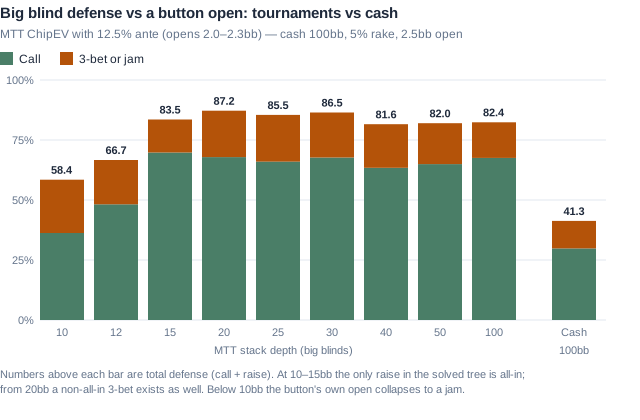
At 100bb, the identical seat and the identical situation is defended 41.3% in raked cash and 82.4% in an ante tournament. Double. Three honest reasons, all pulling the same direction: the antes add a full extra big blind to an 8-max pot, the solved tournament open is smaller (2.0bb to 2.3bb against cash’s 2.5bb), and the ChipEV solves carry no rake. Work the price out and a tournament defense costs about 1.3bb into a 4.8bb pot, around 21% equity needed against cash’s 27%.
The depth curve has a shape worth knowing. Defense is at its widest at 20bb, 87.2%, where the open is a min-raise and your stack still plays. It thins toward 58.4% at 10bb, where defending increasingly means committing your stack: the only raise in that tree is all-in, and even the call puts 10% of your stack in out of position. From 25bb up it settles in the low-to-mid 80s. If you play tournaments, stack depth changes the whole preflop tree, and the big blind feels it before any other seat.
Below 10bb the button stops min-raising altogether; every solved opening raise at 3 to 8 big blinds is all-in. Defending stops being a range question and becomes a calling-off question:
| Stack depth | BB calls a button jam |
|---|---|
| 3bb | 96.4% |
| 4bb | 73.8% |
| 5bb | 55.5% |
| 6bb | 46.0% |
| 8bb | 34.9% |
At 3 big blinds you call with almost everything you’re dealt. At 8, roughly one hand in three. If either of those numbers surprised you, that’s the depth range to drill first.
What over-folding actually costs
Folding the big blind too much is the most common version of this leak, and coaching sites agree while offering no numbers: PokerCoaching’s big blind guide describes players “folding too often” on one side and “defending far too wide” on the other, and quantifies neither. The solve files can.
Defend only the obvious premium set against a button open (pairs 77+, ATs and better, AJo and better, KQ suited and offsuit) and you keep about two-thirds of the value. The rest, 9.6bb per 100 button opens faced, is surrendered before the flop. No postflop skill is involved in fixing it, which is what makes it the cheapest real leak a preflop chart can close.
And the money is not where players think it is. Of the 90 hands the solver defends most of the time against a button open, only five are within 0.03bb of a free fold. The bottom of the range is nearly costless to muck; the middle isn’t. K5s is worth 0.33bb defended, more than 98s at 0.28bb. Q6s, T7s, 86s all carry around 0.2bb. Those are exactly the hands over-folders throw away.
What you can safely ignore: the mixes. Q9o defends 27% of the time and folds the rest, and the EV of either choice rounds to zero. Whether you defend it never matters; whether you defend K5s always does. That’s the same pattern our range memorization study found across the whole database: frequencies are decoration, range boundaries are money.
Common big blind mistakes
Playing one defense range. The correct range vs a button open is more than twice the correct range vs UTG. One memorized “BB defense chart” is wrong in most spots by construction.
Carrying a range across formats. A cash chart in an ante tournament under-defends by 40 points. A tournament chart in a raked cash game torches money in the other direction. Check which game your chart was solved for, including its rake and ante, before trusting it.
Never 3-betting light. If your big blind 3-bets are AA-QQ and AK, you’re playing a fraction of the solver’s 11.5% against late opens, and observant openers get to continue with exactly the right hands against you.
Defending the same range multiway. Everything above is heads-up: one opener, everyone else out. When callers are already in, defense tightens even though the price improves, because multiway pots cut equity realization hard.
Auto-checking when the small blind limps. Facing a small blind complete, the solver raises 40.4% of the time. A free flop is fine; surrendering the betting lead with your entire range is not. The small blind’s side of that battle, and how both seats play it at every depth, is mapped in our blind vs blind strategy guide.
Drilling it
Reading a defense chart and playing one are different skills, and the gap shows up as EV loss. GTO Preflop’s trainer deals you cash spots from 50 to 200 big blinds and tournament spots from 3 to 12, grades each decision against the solved answer, and reports EV loss per 100 hands with an ELO rating attached, so big blind spots come up constantly at exactly the depths where the money is. The range viewer covers every node in this article at every depth in the library. The app is free to download on iOS and Android.
The best preflop chart apps roundup compares it honestly against six alternatives if you want the full market picture first.
FAQ
How much should you defend the big blind?
Against a single 2.5bb open in 100bb raked cash: 18.3% vs UTG, 25.6% vs the hijack, 31.4% vs the cutoff, 41.3% vs the button, 50.0% vs a small blind 3bb open. In ante tournaments those numbers roughly double at most depths, peaking at 87.2% against a button min-raise at 20bb.
Should you call or 3-bet from the big blind?
Both, in a roughly 3-to-1 ratio. Against a button open the solver calls 29.8% of hands and 3-bets 11.5%, mixing premium value with blocker-driven bluffs like A5o and K2s. A call-only defense is exploitable and leaves the 3-bet EV on the table.
Why defend so little against early position opens?
Because the opener’s range is strong and you’re out of position with no way to make their continues awkward. 18.3% against UTG isn’t nitty, it’s the equilibrium: the same solver that defends 41.3% against the button chooses it. The discount and the pot odds don’t change with the opener’s seat; the range you’re up against does.
Does minimum defense frequency apply to big blind defense?
Not as a target. MDF assumes the raiser’s bluffs lose the pot when called, which is false preflop, where every open has live equity and position. The solver defends far below naive MDF against early opens (18.3% vs 37.5%) and above it against the button (41.3%), and both are correct.
How do antes change big blind defense?
They add roughly a full big blind to an 8-max pot, which improves your price by several equity points, and tournament opens are smaller too. Measured result: 82.4% defense against a button open at 100bb with antes, against 41.3% in raked cash at the same depth.
How wide do you call an all-in from the big blind?
Depth is everything. Against a button jam with a 12.5% ante, the solver calls 96.4% of hands at 3bb, 55.5% at 5bb, and 34.9% at 8bb. If you fold a third of your hands to a 3bb jam, you’re burning chips at the fastest rate the preflop tree allows.
Sources
- GTO Preflop’s on-device solve library — 503 Brotli-compressed solution files, 11,385 decision points, 1,924,065 hand strategies; big blind defense nodes read directly and combo-weighted on August 27, 2026
- Method validation — first-in opening frequencies reproduced from the same traversal (8-max, 100bb, 5% rake / 4bb cap: 13.9% UTG, 43.7% button) and matched against the figures printed on GTO Preflop’s App Store screenshots
- GTO Preflop on the App Store — version 3.0.30, free download, 4.8/5 from 240 ratings, checked August 27, 2026
- GTO Preflop on Google Play — 4.6/5 from 3.2K reviews, 100K+ downloads, checked August 27, 2026
- GTO Wizard: MDF & Alpha — source for the minimum defense frequency formula, MDF = pot / (bet + pot), accessed August 27, 2026
- PokerCoaching: Mastering Big Blind Strategy — the qualitative over-folding / over-defending framing this article puts numbers on, accessed August 27, 2026
Every figure on this page was computed from GTO Preflop’s shipped solve files on August 27, 2026 and is reproducible from the app. Cash figures use the 8-max, 100bb, 5% rake / 4bb cap solves with a 2.5bb open (3bb from the small blind); tournament figures use the ChipEV solves with a 12.5% ante and solved open sizes of 2.0-2.3bb. EVs are in big blinds with folding fixed at zero.